
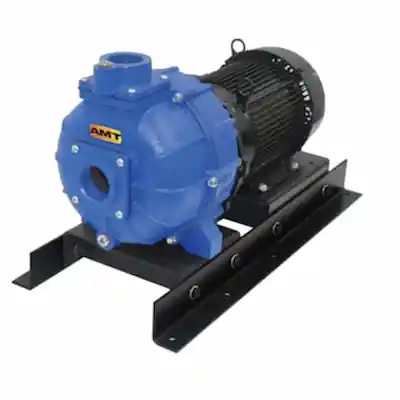
People buy the wrong one of these constantly, and the symptom is always the same: water arrives, but not with enough force to be useful.
The confusion is understandable. Both are water pumps in the ordinary sense. But they solve opposite problems, and buying one when you needed the other wastes the money entirely.
What Is the Difference Between a Booster Pump and a Water Pump?
The difference between a booster pump and a water pump is what each one produces. A water pump moves water from one place to another, creating flow where there was none. A booster pump raises the pressure of water that is already arriving, and cannot help if there is no supply to begin with. If nothing comes out of the tap, you need a water pump. If water comes out weakly, you need a booster.
Key Takeaways
- A water pump creates flow. A booster pump raises pressure in a supply that already exists.
- No water at all is a supply problem. A booster pump will not fix it and can be damaged by running dry.
- Weak flow with adequate supply is a pressure problem, and that is what a booster is for.
- Diagnose before buying. Low pressure at one fixture is usually a blockage, not a system-wide fault.
- Boosters are installed permanently on the supply line. Transfer and utility pumps are portable by design.
Water Pump vs Booster Pump at a Glance
| Water pump | Booster pump | |
|---|---|---|
| What it does | Moves water, creates flow | Raises pressure of existing flow |
| Use it when | There is no water where you need it | Water arrives but too weakly |
| Typical install | At the source: well, tank, sump | On the supply line, after the meter or tank |
| Common types | Centrifugal, submersible, diaphragm, jet | Single or multi-stage inline |
| Runs when | You need water moved | Demand drops pressure below a set point |
| Fails if | Run dry, or fed water full of solids | Fed no water at all, or oversized for the line |
How a Water Pump Works
A water pump creates movement. It draws water in from a source and pushes it out somewhere else, and the source is usually somewhere the water will not travel on its own: a well, a sump, a tank, a flooded room.
The main families each suit a different source. Centrifugal pumps move high volumes of clean water. Submersible pumps sit in the water and push upward, which is what makes deep wells possible. Diaphragm pumps handle water carrying solids that would jam an impeller. Jet pumps draw from shallow wells above ground.
What they share is that they start with water that is not moving and make it move.
How a Booster Pump Works
A booster pump does not create supply. It takes water already flowing through a line and increases its pressure, which is why a booster pump is defined by the pressure it adds rather than the volume it moves.
It sits inline, usually after the meter or the storage tank, and switches on when demand pulls pressure below a set point. A pressure sensor and a small tank keep it from cycling on every tap.
Multi-stage designs stack impellers in series, each adding pressure to the last. That is how a compact unit produces pressure a single impeller could not.
How to Tell Which One You Need
Turn on a tap and watch what happens.
Nothing at all means no supply. That is a water pump problem, or a well problem, and a booster added to an empty line will run dry and destroy itself.
A weak but steady stream means supply is fine and pressure is not. That is what a booster is built for.
Strong pressure at one fixture and weak at another is neither. That is a blockage, a partly closed valve or an undersized pipe run, and no pump fixes it.
Pressure that drops only when several fixtures run at once usually means the supply line is undersized for peak demand. A booster helps here, but so does correcting the pipework.
Where Each One Is Installed
Water pumps go at the source. A submersible hangs in the well, a sump pump sits in the pit, a transfer pump goes wherever the water is that day.
Booster pumps go on the line, downstream of the supply and upstream of the fixtures they serve. Position matters: a booster installed before a storage tank raises pressure into the tank rather than into the house, which achieves nothing.
Choosing the Right Pump
For moving water, size on flow rate against real head, including the horizontal run. For boosting, size on the pressure gap you need to close and the number of fixtures drawing at once.
Oversizing a booster is the common mistake. Too much pressure stresses joints and fittings and shortens the life of everything downstream.
It also shortens the booster’s own life, because a pump that hits cut-out instantly ends up cycling constantly. Our guide to booster pump lifespan sets out what that costs in service years.
Our ultimate guide to buying water pumps covers sizing across both families in more detail.
Frequently Asked Questions
What is the difference between a booster pump and a normal pump?
The difference between a booster pump and a normal pump is that a booster raises the pressure of water already in the line, while a normal water pump moves water from one place to another and creates flow where there was none. A booster needs an existing supply to work on. Put simply, no water at all needs a water pump, while weak water needs a booster.
Is a booster pump worth it?
A booster pump is worth it when the supply is adequate but the pressure is not, which is common at the end of a long service line, on upper floors, or where several fixtures run at once. It is not worth it if the real problem is a blockage, a partly closed valve or an undersized pipe, because a booster masks those faults instead of fixing them.
Where should a booster pump be installed?
A booster pump should be installed on the supply line downstream of the water source and upstream of the fixtures it serves, typically after the meter or after a storage tank. Installing it before a tank simply pressurizes the tank rather than the building. It needs accessible space for servicing, protection from freezing, and a power supply rated for the motor.
Can a booster pump run without water?
No, a booster pump cannot run without water and will be damaged if it does. Running dry destroys the seals within minutes because there is no water to carry heat away from the mechanism. Most units include a low-pressure or dry-run cutout for that reason. If your supply is intermittent, fix the supply before adding a booster to the line.
Pumps and Parts
We stock both families along with the wear parts that service them. If you are diagnosing low pressure and are not certain which side of this line your problem sits on, describe what happens at the tap and we will work it out with you.
For self-priming surface installations see our Franklin Electric self-priming pumps, or the DR series close-coupled centrifugal pump for fixed transfer duty.
Diaphragm setups running solids are covered in CH&E and Magnum replacement parts. Browse the full water pump range, or start from the Ken’s Distributing homepage if you are new here.