
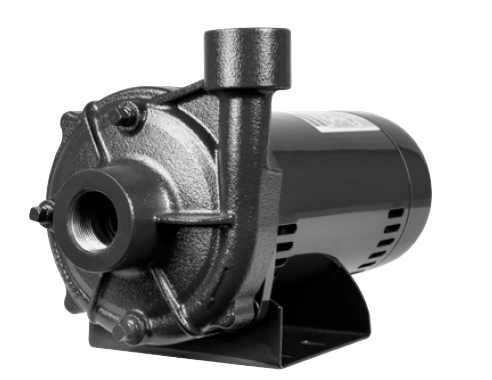
Ask which is better, a centrifugal pump or a self priming pump, and the question already contains a mistake. The two are not rival technologies. A self priming pump is a centrifugal pump, built with an extra chamber that lets it clear air out of its own suction line.
Getting this straight matters, because the real decision is not about pumping principle at all. It is about where the pump sits relative to the water, and that single fact decides which one you need.
Are Centrifugal Pumps Self Priming?
No. A standard centrifugal pump is not self priming. Its impeller can move liquid but not air, so if the casing is full of air the pump spins and delivers nothing. It has to be primed, meaning the casing and suction line are filled with liquid, before it will pump at all.
Key Takeaways
- A self priming pump is a type of centrifugal pump, not an alternative to one.
- Standard centrifugal pumps must be primed manually or fed by flooded suction.
- Self priming models carry a liquid reservoir that purges air from the suction line.
- The practical suction lift ceiling is roughly 20 to 25 feet, not the theoretical 33.9.
- Self priming costs efficiency and size, so use it only when the pump sits above the water.
How Self Priming Actually Works
On startup the impeller churns the liquid held in the priming chamber and mixes it with air drawn from the suction line. That air and water mixture is thrown into the chamber, where the air separates out and escapes through the discharge while the water falls back to be recirculated.
Repeat this over 30 seconds to several minutes and the suction line is gradually evacuated, atmospheric pressure pushes water up it, and the pump moves into normal operation. Nothing exotic is happening. The pump is simply using retained water as the medium to pull a partial vacuum on its own suction.
Two consequences follow. The chamber must contain liquid before you start, so the pump is self priming and not self filling. And priming is not instant, which matters for any automatic system expected to start under load.
Centrifugal or Self Priming: Side by Side
| Standard centrifugal | Self priming centrifugal | |
|---|---|---|
| Pump position | At or below liquid level | Above liquid level |
| Priming | Manual, or flooded suction | Automatic after first fill |
| Foot valve needed | Usually yes on suction lift | No |
| Efficiency at same duty | Higher | Lower, from recirculation |
| Size and cost | Smaller, cheaper | Larger, more expensive |
| Time to full flow | Immediate | 30 seconds to several minutes |
| Typical use | Boosting, circulation, in-line | Dewatering, tank unloading, portable |
Which One Does the Job?
Choose a standard centrifugal pump when
- The pump sits at or below the water level, so suction is flooded.
- It runs continuously and efficiency drives the operating cost.
- The installation is fixed and priming is a one-time commissioning task.
- Space is tight, since the same duty comes in a smaller casing.
Choose a self priming pump when
- The pump has to sit above the water, drawing from a sump, pond, tank or river.
- It starts and stops unattended and nobody is there to prime it.
- The suction line will pick up air, which a standard pump cannot clear.
- The pump is portable and gets moved between water sources.
The Foot Valve Problem
A standard centrifugal pump on suction lift usually depends on a foot valve, a check valve at the bottom of the suction line that holds the water column in place when the pump stops. In theory it stays primed indefinitely. In practice the valve gets held open by grit, or the seat wears, and the line drains back overnight.
The pump then starts dry the next morning. If nobody notices, the mechanical seal is the first casualty. Chronic foot valve failure is the most common reason an operator switches to self priming, and it is usually the correct call: the efficiency penalty is real but small next to repeated dry starts.
Why Suction Lift Has a Hard Ceiling
No pump sucks water up. Atmospheric pressure pushes it, and the pump only creates the low pressure region that lets it happen. At sea level that gives an absolute maximum of 33.9 feet, and every real-world factor erodes it.
Friction in the suction pipe, elevation above sea level, warm water closer to its vapor point and any air leak in a joint all subtract from the available head. The margin that remains is described by net positive suction head, and running below what the pump requires produces cavitation, which chews out the impeller (NPSH explained).
The working conclusion for most sites: design for 20 to 25 feet of lift and use a short, wide, airtight suction line. If the water is deeper than that, a submersible pump is the correct specification rather than a bigger surface pump.
Keeping Either Type Running
Both types fail in the same places, because underneath they are the same machine: mechanical seal, bearings and impeller. Self priming units add one maintenance item, which is confirming the priming chamber still holds liquid after a service or a long shutdown. Our centrifugal pump maintenance guide covers the shared routine.
It is also worth not confusing either of these with a pressure booster, which is a different job again. That distinction is set out in our booster pump guide.
Frequently Asked Questions
Are centrifugal pumps self priming?
Standard centrifugal pumps are not self priming. The impeller can only move liquid, so if the casing and suction line contain air the pump spins without shifting anything. A self priming centrifugal pump solves this with a built-in reservoir that holds liquid between runs and uses it to purge air from the suction line automatically.
What is the difference between a centrifugal pump and a self priming pump?
There is no difference in pumping principle, because a self priming pump is a centrifugal pump. The difference is the casing. A self priming model adds a priming chamber that retains liquid and separates air, letting it clear its own suction line. A standard centrifugal pump needs flooded suction or manual priming before every start.
How high can a self priming pump lift water?
A self priming pump can typically draw water from about 20 to 25 feet below the pump on a good installation. The theoretical ceiling at sea level is 33.9 feet, but friction in the suction line, altitude, warm water and air leaks all cut into it. Above roughly 25 feet a submersible pump is the right specification instead.
Can a self priming pump run dry?
No. A self priming pump must start with liquid already in its priming chamber, and it relies on that liquid to cool and lubricate the mechanical seal. If the chamber has drained the pump will not prime, and running it in that state damages the seal within minutes. Check the chamber after any service or long shutdown.
Self Priming and Centrifugal Pumps at Ken’s Distributing
Ken’s Distributing stocks both types, including the Franklin Electric self priming range for suction lift applications. Tell us the vertical lift, the flow you need and what the water contains, and we will confirm which configuration fits before you order.