
A rack of AI accelerators throws off heat on a scale that traditional server rooms never had to handle, and every method of removing that heat ends up moving water somewhere.
That creates a pumping problem most facilities teams inherit rather than design for: chilled water circulation, condensate removal from CRAC and CRAH units, and pressure stability across a hydronic loop that cannot be allowed to fail.
What Pumps Does an AI Data Center Actually Need?
An AI data center needs three distinct pump duties: condensate removal from cooling units, circulation through chilled water and hydronic loops, and transfer to and from cooling towers. Losing any one of the three takes the hall offline, which is why these sites lean on industrial water pumps more heavily than most facilities. Condensate is the one most often underspecified, because a single high-density cooling unit can produce continuous condensate that a residential-grade pump was never rated to handle around the clock.
Key Takeaways
- Condensate removal is continuous duty in a data center, not intermittent as it is in a home.
- A safety switch that cuts the cooling unit before an overflow matters more than pump capacity.
- Chilled water loops need stable head, not maximum flow. Oversizing wastes energy and stresses joints.
- Redundancy belongs on the pump, not just the chiller. A failed condensate pump takes a rack offline.
- Specify for the duty cycle you will actually run, which in a data center is effectively permanent.
Cooling Method and What It Demands of the Pump
| Cooling approach | Water movement required | Pump duty |
|---|---|---|
| CRAC / CRAH air cooling | Condensate removal from each unit | Continuous condensate pump with safety cutout |
| Chilled water loop | Circulation between chiller and coils | Steady head, continuous duty circulation |
| Cooling tower | Transfer to and from the tower | High volume transfer, corrosion resistant |
| Direct-to-chip liquid cooling | Coolant distribution to the rack | Precise, low pulsation, high reliability |
| Rear-door heat exchangers | Chilled water to the door unit | Circulation plus condensate handling |
Condensate Removal Is the Overlooked Failure Point
Cooling equipment pulls moisture out of the air, and that water has to go somewhere. In a house it trickles. In a facility running dense compute, it runs continuously.
The failure mode is unglamorous and expensive. A blocked or failed condensate pump backs water up into the drain pan, the pan overflows, and the water lands on whatever is beneath it.
Two things prevent it. The first is a pump rated for continuous rather than intermittent duty. The second is an overflow safety switch that cuts the cooling unit before the pan reaches the floor, which turns a flood into an alarm.
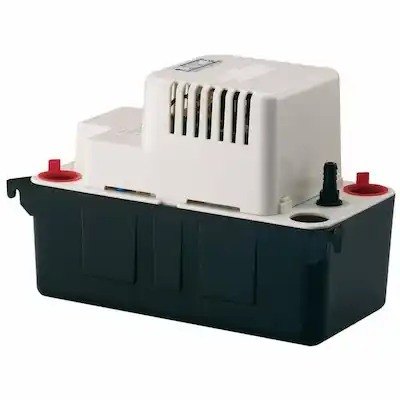
Little Giant’s VCMA and VCL series cover the tank-mounted and low-profile cases, and pair with neutralizers where the condensate is acidic enough to attack the drain line.
Circulation and Chilled Water Loops
Circulation pumps in a hydronic loop are sized on head rather than raw flow. The pump has to overcome the resistance of the pipework, the coils and the fittings, and deliver a stable rate while doing it.
Oversizing is the common error. Too much flow increases pumping energy without improving heat transfer, and adds wear across every joint in the loop.
Franklin Electric’s D and XS series close-coupled centrifugals suit this duty, with the motor and impeller on one shaft so there is no coupling to align or wear in a system meant to run without interruption.
Specifying for Continuous Duty
The difference between a pump that lasts and one that does not is usually the duty rating rather than the brand.
A pump specified for intermittent household use will run in a facility, and will fail early, because the duty cycle it was designed around bears no relation to a load that never stops. Variable speed is standard on these loops, since a variable-frequency drive lets one pump follow a changing heat load instead of cycling.
Materials matter for the same reason. Continuous exposure to condensate, treated loop water or cooling tower water is a corrosion problem, and stainless or appropriately coated wetted parts pay for themselves over a few years.
Build in redundancy at the pump. Facilities routinely specify redundant chillers and then run a single condensate pump under a critical unit.
Frequently Asked Questions
What is a condensate pump used for in a data center?
A condensate pump in a data center removes the water that cooling equipment pulls out of the air, lifting it from the drain pan to a drain line that gravity cannot reach. Because cooling runs continuously in a facility, the pump does too, so it must be rated for continuous duty rather than the intermittent cycle a residential unit assumes.
Why do data centers use water for cooling?
Data centers use water for cooling because water carries heat away far more efficiently than air, which matters as rack density rises. Air cooling struggles with high-density AI hardware, so facilities move to chilled water loops, cooling towers or direct liquid cooling. Each of those approaches needs water circulated reliably, and every one of them produces condensate that has to be removed.
What happens if a condensate pump fails?
If a condensate pump fails, water backs up in the drain pan until it overflows onto whatever sits below, which in a data center can mean equipment damage and downtime. An overflow safety switch prevents this by shutting off the cooling unit before the pan fills, converting a potential flood into an alarm and a service call.
How do you size a circulation pump for a chilled water loop?
You size a circulation pump for a chilled water loop on total dynamic head and required flow together, not horsepower. Calculate the resistance of the pipework, coils and fittings, then select a pump that delivers the needed flow at that head. Oversizing raises energy use and wear without improving heat transfer, so match the pump to the loop rather than over-specifying.
Pumps for Facility Water Systems
We supply condensate, circulation and transfer pumps for mechanical systems, along with the wear parts that keep them running. Continuous duty applications get specified rather than picked off a shelf, so tell us the load, the head and what the water contains.
For surface installations see our Franklin Electric surface pumps, or Wacker Neuson centrifugal pumps for higher volume transfer duty.
Efficiency in continuous-duty systems is covered further in our piece on sustainable pump selection. Browse the full water pump range to compare specifications.