
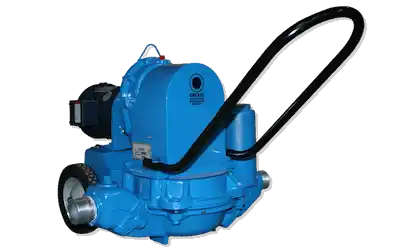
A Mud Hog does the job nothing else wants: pumping water so full of mud and grit that a centrifugal would clog or wear out inside a shift.
When one starts losing its bite, the pump has usually not failed. One wear part has, and which one it is shows in how the output falls off.
What Is a Mud Hog Pump?
A Mud Hog pump is a diaphragm trash pump built for slurry and debris-laden water. It flexes a membrane to move a fixed volume with every stroke rather than spinning liquid outward, which is why it keeps working in mud and tolerates a suction line that keeps running dry.
Key Takeaways
- Falling output means a wear part, not usually a dead pump.
- The diaphragm softens before it splits, so performance fades first.
- Worn check valves look identical to a tired diaphragm from outside.
- Check the strainer and suction joints before opening the pump.
- Diaphragms are sized to the discharge, not measured off the old part.
Diagnosing a Pump That Has Lost Its Bite
| Symptom | Likely cause | Where to look |
|---|---|---|
| Output falls gradually over weeks | Diaphragm fatiguing | Inside the cover |
| Output drops but pump sounds normal | Check valves or seats worn | Valve chamber |
| Pump will not pull a prime | Air leak on suction | Hose joints and clamps |
| Runs, then loses flow under load | Blocked strainer | Inlet, outside the pump |
| Weeping at the cover | Cover bolts or gasket | Torque the bolts evenly |
Work down that list from the bottom up in terms of effort. The strainer and the suction joints cost nothing to inspect and account for a good share of call-outs, while the diaphragm and valves need the cover off.
Why the Diaphragm Fades Rather Than Fails
The membrane is what does the pumping, and it wears by flexing rather than by rubbing. Millions of strokes gradually stiffen and thin it, so displacement per stroke drops before anything tears.
That is why the complaint is nearly always “it is not moving what it used to” rather than “it stopped”. By the time a diaphragm splits it has usually been underperforming for weeks. The mechanism behind that is set out in this overview of the diaphragm pump, and the service life it can be expected to give is in our guide to diaphragm pump lifespan.
Check the Valves at the Same Time
Balls, flappers and seats wear at a similar rate to the diaphragm, and worn ones let pumped liquid slip backward on every stroke. From outside the pump that is indistinguishable from a tired membrane.
Replacing both together costs a little more than the diaphragm alone and avoids opening the same pump twice in a season. It also removes the ambiguity, since a pump with fresh diaphragm and valves that still underperforms has a suction problem instead.
Choosing the Replacement
- Size by discharge, so a 2 inch pump takes a 2 inch diaphragm.
- Never measure the old one. A stretched or torn part no longer reads true.
- Pick material by liquid: rubber for general site water, neoprene for wider chemical and temperature range.
- Re-torque cover bolts in a cross pattern after the first few hours.
- Keep a spare on the truck. The failure is predictable, the timing is not.
The step-by-step replacement is covered in our guide to replacing a Mud Hog diaphragm, and how the pump principle compares to a centrifugal is in how a diaphragm pump works.
Frequently Asked Questions
What is a Mud Hog pump?
A Mud Hog pump is a diaphragm trash pump built for water thick with mud, silt and debris, the conditions that stop a centrifugal pump within minutes. It works by flexing a membrane to move a fixed volume each stroke, so it keeps pumping through slurry and tolerates a suction line that keeps running dry.
Why is my diaphragm pump not pumping?
A diaphragm pump stops pumping for one of four reasons: a split or stretched diaphragm, worn check valve balls or seats, a blocked strainer, or air entering the suction line. Work through them in that order, because the first two are inside the pump and the last two cost nothing to check.
How do you troubleshoot a diaphragm pump?
Troubleshoot a diaphragm pump from the outside in. Check the strainer and suction hose for blockage or collapse, confirm every suction joint is airtight, then open the cover and inspect the diaphragm and valves together. Falling output rather than a sudden stop almost always means the wet end rather than the engine.
Where can I get Mud Hog replacement parts?
Mud Hog replacement diaphragms are stocked in 2 and 3 inch sizes and in rubber and neoprene, sold by pump distributors rather than general suppliers because they are sized to the pump series. Match the size to the discharge and the material to the liquid rather than measuring the old part, which has stretched.
Mud Hog Parts at Ken’s Distributing
Ken’s Distributing stocks Mud Hog replacement diaphragms including the 2 inch rubber diaphragm and the 3 inch neoprene version, alongside the wider diaphragm pump parts range covering rubber, neoprene, Buna-N and TPE.
Send us the pump size and what the liquid contains, and we will confirm the right diaphragm and valve kit before you order.