
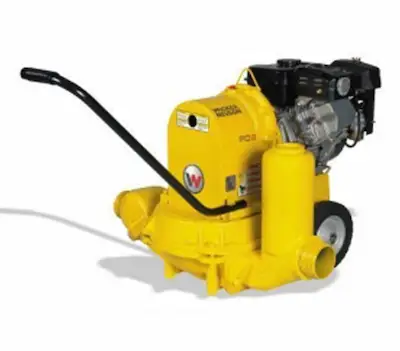
Replacing a mud hog pump diaphragm is a hand-tool job that most crews finish in under an hour on the tailgate.
Confirm the diaphragm is the actual fault before ordering, because a Mud Hog losing suction is not always the diaphragm.
Drain and flush the pump, pull the cover plate, lift out the worn diaphragm with its backing plates, seat the new one, then torque the cover bolts evenly in a cross or star pattern.
Speed is not the goal, because a diaphragm that seats tears unevenly early, and a torn membrane mid-job floods the excavation.
What This Pump Does, in One Sentence
A hog pump moves dirty, gritty, solids-loaded water out of a hole and keeps it moving without clogging or grinding itself apart.
Everything else protects that outcome, which is why the mud hog pump family uses a flexing membrane instead of a spinning impeller.
Why Crews Pick This Diaphragm Pump for Muddy Water
- Solids handling. Published manufacturer specifications for diaphragm trash pumps in this class list suspended-solids passage of roughly 1.5 to 2.25 inches. Sources differ because 3-inch and 4-inch bodies use different valve geometry, so read your model’s spec sheet.
- Portability. A 2-inch unit drops into a pickup bed, while 3-inch and 4-inch units ride on carts, skids, or trailers.
- Run-dry tolerance. The pump runs dry for long stretches without cooking a seal, which matters when a sump empties overnight.
- Lower maintenance than centrifugal options. No impeller wear, no mechanical seal weeps, and the sacrificial part is cheap.
- Mount flexibility. The same pump end bolts onto skid packages, carts, and hydraulic power units.
Standardizing on one diaphragm size cuts the part numbers you stock, which is where downtime usually starts.
How This Mud Pump Operates
The pump flexes a reinforced membrane inside a sealed chamber, creating suction on the upstroke and discharge pressure on the downstroke, while flapper valves force flow in one direction.
Because nothing spins in the fluid path, an abrasive slurry passes through instead of grinding against a rotating part.
Operational Steps for a Hog Pump
Setup and priming. Set the pump on firm, level ground close to the water, and keep the suction strainer off the bottom of the sump so it does not bury itself.
These pumps self-prime from a dry start, but keep the lift realistic.
Manufacturer literature for this class commonly lists maximum suction lift near 20 feet vertical, or 75 feet horizontal with a foot valve.
The pumping cycle. Start at low throttle and let the pump water for thirty seconds before bringing it up to speed.
A steady, pulsing discharge is normal on a positive-displacement machine, not a fault.
If flow drops off, look for a plugged strainer, a collapsed suction hose, or a stone holding a flapper open.
Shutdown and purge. Throttle down before shutting off, then run clean water through for a minute if any is available.
Open the drain plug so grit does not cure against the membrane, and store the unit out of direct sunlight, because UV degrades rubber faster than pumping does.
Replacing the Diaphragm, Step by Step
You need a socket set, a torque wrench, and a clean rag.
- Shut down and isolate. Kill the engine, pull the spark plug lead or lock out the electrical supply, and let the unit cool.
- Drain and flush. Empty the chamber and rinse out sediment so debris does not fall onto the new sealing face.
- Disconnect the hoses. Pull the suction and discharge lines so the covers come off without fighting plumbing.
- Remove the cover plate. Back the bolts out in a cross pattern, a half turn at a time, so the plate lifts evenly.
- Lift out the old diaphragm. Note the orientation of the backing plates and connecting rod hardware first, and photograph it the first time.
- Inspect while it is open. Check the flappers and valve assemblies at every diaphragm replacement, because a new membrane does nothing if a worn flapper leaks back.
- Clean the sealing faces. Scrape the flange and wipe it dry, since one grain of sand under the bead starts a leak path.
- Seat the new diaphragm. Line up the bolt holes without stretching the material and confirm the bead sits flat in its groove.
- Torque in a star pattern. Tighten the cover bolts evenly to the value in your operator manual. Uneven clamp load is the most common cause of an early tear, because it concentrates stress in one arc.
- Replace both if the pump has two. On a double-diaphragm pump, change both membranes together, since a new one running against a half-worn one puts you back under the cover in weeks.
- Test first. Reconnect the hoses, run clean water, and check the covers for weeping before it goes back in the hole.
Pick the compound to match the fluid, not the price tag, because rubber suits clean water with no chemical exposure, while Buna and nitrile handle oil, fuel, and hydrocarbon-contaminated water.
For continuous duty where replacement frequency has gotten out of hand, TPE and Santoprene diaphragms last longer per cycle, and neoprene diaphragms remain the workhorse for construction dewatering, slurry transfer, and sediment-laden groundwater.
What Sets This Pump Apart
Reliability here comes from what the machine does not have, because a centrifugal pump running an abrasive slurry erodes its impeller and wear plate continuously, and performance falls off gradually until someone finally opens it up.
A diaphragm pump concentrates that wear into one replaceable part, so failure is obvious, cheap, and predictable.
Flappers also lift out of the flow path when solids pass, and low operating speed means less rapid wear in gritty fluids.
Diaphragms built to OEM-fit dimensions and part numbers mean a unit bought years ago can be serviced today with current aftermarket stock.
Specifications and What Comes With the Pump
These are the numbers that drive transport and power planning.
- Solids diameter: roughly 1.5 to 2.25 inches of suspended solids, depending on model and port size.
- Discharge sizes: 2-inch, 3-inch, and 4-inch, covering the 200, 300, and 400 series.
- Flow rate: approximately 30 to 110 gallons per minute across the size range.
- Power options: gas engine, electric motor, or hydraulic drive off a carrier machine.
- Transport planning: 2-inch units are a two-person lift, while 3-inch and 4-inch units need a cart, skid, or trailer. Confirm against the data plate on your unit.
- Documentation: an operator manual, an exploded parts breakdown with part numbers, and written warranty terms. Confirm warranty length with your seller, since it varies by drive type.
Applications, Including Seepage Areas
These pumps show up wherever water arrives dirty and slowly.
- Seepage area dewatering. Trench bottoms, footing excavations, and slow groundwater infiltration, where inflow is gritty, intermittent, and too thin to keep a centrifugal pump primed.
- Construction and tunneling. Sump duty in tunnels, shafts, and pits where water carries fines and spoil.
- Horizontal directional drilling. Recovering and transferring drilling fluids and returns during HDD work.
- Grout transfer. Moving grout and thin cementitious materials on the job.
- Drywall and masonry finishing. Wash water and joint compound slurry that would set up inside other equipment.
- Municipal and environmental work. Wastewater transfer, septic sludge, and remediation sites where fluid is thick and unpredictable.
Who Should Buy One
Construction contractors and site supervisors who need dewatering that does not stop when the water turns to mud.
Rental companies and equipment fleets that need machines coming back in one piece. Run-dry tolerance matters most here, because customers leave pumps running and this one forgives that.
Utility crews handling dewatering around water, sewer, and telecom work, where excavations fill with silty groundwater on nobody’s schedule.
Diaphragm Pump Versus Other Pump Types
| Factor | Diaphragm pump | Centrifugal / trash pump |
|---|---|---|
| Solids handling | Passes large solids through flapper valves | Limited to impeller clearance |
| Abrasive slurry | Wear isolated to one cheap part | Continuous impeller and wear plate erosion |
| Run dry | Tolerates extended dry running | Seal damage risk within minutes |
| Priming | Self-priming from a dry start | Often needs a priming pot |
| Flow rate | Lower, steady, pulsing | Much higher volume |
| Best fit | Thick, gritty, intermittent flow | High-volume clean water |
Choose the diaphragm pump when the fluid is thick, the solids are large, the inflow is intermittent, or the pump will sit unattended.
Choose a trash pump to move clean water fast, such as emptying a tank or running a bypass.
One naming trap is worth clearing up, because the mud pumps used on drilling rigs are high-pressure reciprocating machines that circulate drilling fluids downhole, a different class of equipment despite the shared word.
For the mechanical background on membrane pumps, this diaphragm pump overview covers the operating principle in more depth.
Safety, Maintenance, and Spare Parts
Daily inspection takes two minutes and prevents most field failures.
Observe the cover plate for weeping, check the suction hose for soft spots, and look at the strainer and discharge coupling.
Listen under load, because a change in the stroke sound shows up before a visible failure.
Service intervals. Published service guidance puts first inspection at 500 to 1,000 operating hours in construction use, and abrasive work shortens that considerably.
Flush the pump after sediment-laden or chemically active fluids.
A basic spare parts kit. Stock one diaphragm per pump in the compound you run, a set of flappers, a valve assembly, cover plate gaskets and bolts, and a spare strainer. That kit costs less than a day of crew time.
Torque and coupling checks. Re-check cover bolt torque after the first few hours on a fresh diaphragm, since the material takes a set and clamp load drops.
Check hose clamps and coupling fasteners weekly, because vibration walks them loose faster on a reciprocating machine.
What Size Solids Can a Mud Hog Pump Handle?
Solids size for this pump class generally falls between 1.5 and 2.25 inches in diameter, set by model and discharge size. Published specs vary because valve geometry differs across the 2-inch, 3-inch, and 4-inch bodies. Grit and sand pass through, which is why contractors select a diaphragm pump for dewatering applications. Confirm the spec sheet for your model, since undersizing the rating is how flappers jam open.
Does a Diaphragm Pump Need Priming, and Can It Run Dry?
Diaphragm pumps self-prime from a dry start, so there is no priming pot to fill. The membrane creates suction lift on its own, commonly rated near 20 feet vertical in manufacturer literature. These pumps also run dry for long periods without damaging internal components, because no mechanical seal relies on liquid for cooling. That suits unattended seepage areas where a sump empties overnight.
How Often Should the Diaphragm Be Replaced, and What Does Service Cost?
Diaphragm replacement starts with inspection at 500 to 1,000 operating hours in normal construction use, with abrasive slurry pushing that lower. The membrane is an inexpensive wear part, and labor runs under an hour with hand tools. Pricing varies by size and compound, so request a current quote for your part number. The real cost is downtime, which is why one spare per pump pays for itself.
Do These Diaphragms Fit Skid Packages and Different Motor Setups?
Skid packages, cart mounts, and hydraulic power units share the same pump end, so the diaphragm part number follows pump size and series, not the drive. A 3-inch pump takes the same diaphragm whether it is engine-driven or hydraulically driven. Confirm the series and discharge size, then match the compound to your fluid. Stock on common 3-inch replacement diaphragms usually ships faster than a factory backorder.
Order Parts or Get Help With a Configuration
Match your pump series and discharge size to the right part number, pick the compound that fits your fluid, and order a spare before you need one.
For custom skid or motor configurations, or if you are unsure which series you have, send the model number stamped on the pump instead of guessing.
Spec sheets, parts breakdowns, and material compatibility charts are available on request.
Call (303) 699-7845 or email kendisco@yahoo.com, 8 am to 4:30 pm MST. Ships to all 50 U.S. states and Canada.