
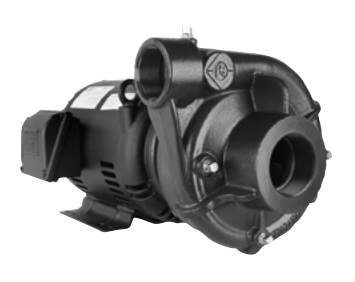
A shallow well jet pump is the workhorse of properties that draw their own water from close to the surface. Cisterns, shallow wells, ponds and lake feeds all end up on one, largely because the pump stays where you can reach it.
The thing worth understanding before buying one is the depth limit, because it is set by physics rather than by horsepower, and no amount of extra motor gets around it.
What Is a Shallow Well Jet Pump?
A shallow well jet pump is a surface-mounted pump with its ejector built onto the pump body, drawing water up a single suction pipe. It can lift water from roughly 25 feet and no further, because atmospheric pressure is doing the pushing and that sets a hard ceiling.
Key Takeaways
- Shallow well means about 25 feet of lift, maximum.
- The pump sits above ground, so servicing needs no well rig.
- It must be primed before the first start and will not clear air on its own.
- Losing prime overnight means a leak on the suction side, not a failing pump.
- Deeper than 25 feet needs a deep well jet pump or a submersible.
How a Jet Pump Actually Works
The clever part is that a jet pump uses its own output to create its suction. A portion of the discharge is routed back through a narrowing nozzle, which speeds the water up and drops its pressure. That low pressure region draws more water in behind it, and the impeller lifts the combined flow.
Two consequences follow. The pump is moving more water internally than it delivers, which is why a jet pump is less efficient than a submersible of the same duty. And it needs liquid present to start the cycle at all, which is why priming is not optional.
Shallow Well, Deep Well or Convertible?
| Shallow well | Deep well | Convertible | |
|---|---|---|---|
| Ejector location | On the pump | Down in the well | Either, reconfigurable |
| Pipes to the well | One | Two | One or two |
| Practical depth | To about 25 ft | Well beyond 25 ft | Both, once set up |
| Efficiency | Better of the two | Lower | Depends on setup |
| Typical use | Cistern, pond, shallow well | Deeper drilled wells | Unknown or changing depth |
Measure the distance from the pump down to the water surface at its lowest seasonal point, not to the bottom of the well. A well that measures 20 feet in spring and 30 in August is a deep well pump job, even though it reads shallow half the year.
Why Choose a Jet Pump Over a Submersible?
The honest case for a jet pump is access. Everything that fails is above ground and reachable with hand tools, so a failed capacitor or a worn seal is an afternoon rather than a rig and a crew. On a cistern or a shallow bore that convenience is worth real money over the life of the system.
The case against is efficiency and noise. A submersible pushes rather than pulls, works at any depth, and runs silently because it is underwater. If the water is deep or the pump would sit near living space, that usually decides it. The full comparison is in our guide to submersible and surface pumps.
Sizing and Setting One Up
Size on the flow your fixtures draw at once and the total head the pump works against, which combines the lift, the pressure you want at the tap and the friction in the pipe. The arithmetic behind that is set out in this pump power reference.
- Keep the suction line short, wide and airtight. Friction and air leaks both eat into the 25 feet you have.
- Fit a foot valve at the bottom of the suction line so the pump holds prime between runs.
- Pair it with a pressure tank sized so the pump is not starting on every small draw.
- Give it ventilation. Surface pumps in closed cupboards run hot.
- Protect it from freezing, since the pump body holds water and a cracked casing is not repairable.
The pressure tank matters more than most owners expect. A tank that has lost its air charge makes the pump short cycle, and that wears out a healthy jet pump faster than anything else on this page. Our notes on annual pump servicing cover checking it.
Franklin Electric Jet Pumps at Ken’s
Franklin Electric builds cast iron shallow well jet pumps for exactly this duty, including the VersaJet shallow well pump, with the wider selection in the jet pump range. Cistern systems are served by the C1 series cistern pump instead.
Surface centrifugal options for transfer and boosting rather than well duty are covered in our look at Franklin centrifugal pumps, and the broader lineup sits in the Franklin Electric pump range.
Frequently Asked Questions
What is a shallow well jet pump?
A shallow well jet pump is a surface pump with its ejector mounted on the pump body, drawing water up a single suction pipe from a well, cistern or pond. It sits above ground rather than in the water, which is why it can be serviced without pulling anything. The trade is depth, since it can only lift water from about 25 feet.
How does a jet pump work?
A jet pump works by sending part of its own discharge back through a nozzle to create suction. The narrowing nozzle speeds the water up and drops its pressure, and that low pressure region pulls more water in behind it. The impeller then lifts the combined flow, so the pump is using its own output to keep the suction going.
How do you prime a shallow well jet pump?
Prime a shallow well jet pump by filling the casing and the entire suction line with water through the priming port before the first start. The pump cannot move air, so any left in the line stops it working. If it loses prime overnight, the foot valve or a joint on the suction side is leaking, not the pump.
How does a deep well jet pump work?
A deep well jet pump works by placing the ejector down in the well instead of on the pump, fed by a second pipe carrying drive water down to it. Putting the venturi near the water rather than at the surface lets the system reach far deeper than 25 feet. The pump itself still sits above ground and stays serviceable.
Getting the Right Pump
Send us the depth to water at its lowest, the flow you need and what the pump will draw from, and we will confirm whether a shallow well jet pump covers it or whether the job needs a deep well or submersible unit. More on the full Franklin lineup is in our Franklin pump overview.
Jet pumps are one of several families Franklin builds, and the rest are set out in the full Franklin lineup.