

Franklin Electric Jet Pumps
- Five series: VersaJet, VersaJet Pro, SWJ, C Series, and RM2
- Shallow well models lift water up to 25 feet
- Convertible Pro (RM2) reaches water up to 100 feet
- Cast iron or rust-free thermoplastic pump cases
- Every series is NSF/ANSI/CAN 372 certified for drinking water
- Send us your model number and we will confirm the right fit
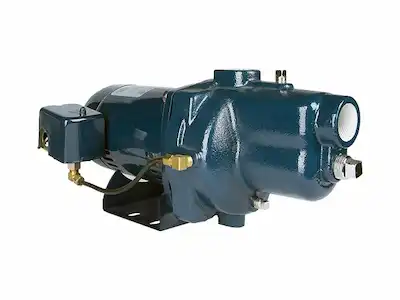
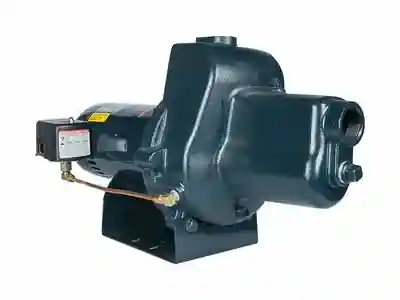


Twenty-five feet is the number that decides which Franklin Electric jet pump you need. Suction alone can lift water about that far, so wells with water inside 25 feet take a shallow well pump, and deeper wells take a convertible pump with an injector. Every Franklin jet pump sits above ground, so nothing electrical goes down the well.
Use the table to find your family, then open that page for models, specs, and sizing.
Pick a Franklin Electric Jet Pump by Well Situation
Measure your pumping water level first. If it stays within 25 feet of the pump, choose a shallow well jet pump. If it sits deeper, drops in dry months, or may go deeper later, choose a convertible jet pump, which reaches water up to 100 feet in the RM2.
| Your situation | Family | Series to look at |
| Water level stays within 25 feet | Shallow well | VersaJet, VersaJet Pro |
| Shallow well where you want a pump body that will not rust | Shallow well | SWJ Series (thermoplastic) |
| Need up to 1.5 HP on a shallow well | Shallow well | VersaJet |
| Water level near 25 feet or rising and falling | Convertible | C Series, RM2 |
| Deep well up to 100 feet, higher flow or pressure | Convertible | Convertible Pro (RM2) |
| Three-phase power at the well | Convertible | RM2 model 1RM2-T |
Shallow Well Jet Pumps
This family keeps the nozzle and venturi inside the pump body, so the install uses one suction pipe. The VersaJet, VersaJet Pro, and SWJ all lift from up to 25 feet, ship with a 30/50 psi pressure switch, and run on 115 or 230 volts.
Their standout feature is choice. The VersaJet goes up to 1.5 HP, the VersaJet Pro swaps nozzles for flow or pressure, and the SWJ will not rust. Compare them on the Franklin shallow well pumps page.
Convertible Jet Pumps
A convertible pump runs as a shallow well pump today and switches to deep well mode with an injector kit and a second pipe. It suits owners whose water level is uncertain or already deep.
The standout is the Convertible Pro (RM2), with up to 23 GPM, a 150 psi rating, and a three-phase 1 HP model. See the convertible jet pump models for conversion steps and specs.
How a Jet Pump Lifts Water
An electric motor spins an impeller that pushes water out to your house. Part of that water loops back through a nozzle and a venturi, the "jet," which creates suction and pulls more water up from the well.
In deep well mode, that jet moves down into the well on a second pipe. Pushing water up from below is what lets a convertible pump reach so much deeper. If you also need bulk water for irrigation or transfer, the other Franklin surface pumps handle that job better.
What to Send for a Jet Pump Quote
- Your current pump's model number, or a photo of its nameplate.
- Your static water level and how far it drops while the pump runs.
- Your well casing size, if you may run deep well mode.
- Your voltage and phase at the pump.
- Anything hard on metal in the water, such as low pH, salt, iron, or sulfur.
Frequently Asked Questions
How deep will a jet pump pull water?
A jet pump pulls water from about 25 feet in shallow well mode, because suction alone cannot lift water much higher. A convertible jet pump with a deep well injector reaches much further. The Franklin Convertible Pro (RM2) lifts water up to 100 feet. Always measure the pumping water level, not the resting level, since the water drops while the pump runs. If that level is close to a limit, step up to the next pump type so it is not working at its edge.
Does a jet pump need a pressure tank?
Yes, a jet pump needs a pressure tank in almost every home water system. The tank stores water under pressure, so the pump does not start every time someone opens a faucet. Without it, the pump turns on and off in rapid cycles, which wears out the motor, the pressure switch, and the seal. Every Franklin jet pump here comes with a pressure switch installed, and that switch is meant to work alongside a properly charged tank.
What are the disadvantages of jet pumps?
The main disadvantages of jet pumps are limited depth and lower efficiency. Shallow well jet pumps stop at about 25 feet of lift, and even convertible models top out around 100 feet. Because part of the water recirculates through the jet, a jet pump uses more power per gallon than a submersible pump. Jet pumps can also lose prime if the suction line leaks air. In return, they are easy to reach and service since they sit above ground.
How do I tell if my jet pump is bad?
You can tell a jet pump is bad when it runs but builds little or no pressure, runs nonstop, or keeps losing prime. Other signs include loud grinding or humming, a tripped breaker, or water leaking at the shaft seal. Before you replace the pump, check the smaller parts around it. A failed pressure switch, a waterlogged pressure tank, or an air leak in the suction pipe can cause the same symptoms while the pump itself is still sound.
Send us your current model number or your well depth, and we will quote the Franklin jet pump that fits your water system.