
Dewatering is the one pumping job where the water is never clean, never the same twice, and always in the way of something expensive.
Which is why the pump that works on one site jams solid on the next, and why the choice is made on what the water carries rather than on flow alone.
What Is a Dewatering Pump?
A dewatering pump is any pump used to remove unwanted water from a site, usually an excavation, trench or foundation. The term describes the job rather than one design, which is why submersibles, engine driven trash pumps and diaphragm pumps all qualify.
Key Takeaways
- Dewatering is a job description, not a pump type.
- Choose on what the water carries, not just on flow.
- Sump pumping is the default method on most sites.
- Line the sump with stone to keep silt out of the pump.
- No power on site means an engine driven unit.
Choosing by What the Water Carries
| Water | Pump type | Why |
|---|---|---|
| Clear groundwater | Submersible | Cheap, quiet, sits in the sump |
| Silty water | Trash pump | Wide clearances pass solids |
| Mud and slurry | Diaphragm | Handles what stops a centrifugal |
| Intermittent seepage | Diaphragm | Tolerates running dry and snoring |
| High volume, clean | Engine driven centrifugal | Flow where there is no power |
That fourth row is the one people learn the hard way. A trench that seeps rather than floods leaves a centrifugal pump running dry between arrivals of water, which destroys its seal, as our pump mechanical seal guide explains. A diaphragm pump simply snores through it.
Setting Up the Sump
Dig the pit lower than the working area and at a corner rather than in the middle, so water runs to it and nobody works around it. Line it with stone or a perforated drum.
The lining is what keeps the pump alive, because silt drawn straight off the bottom erodes the impeller within days, as covered in our pump impeller guide. General background on the practice is in this reference on dewatering.
Sizing for Inflow, Not Optimism
- Measure the refill rate with the pump off.
- Add the lift out of the excavation, which is often significant.
- Add hose friction, which on a long run beats the lift.
- Allow for rain, since the site floods on the worst day.
- Read flow at that head, never at the headline figure.
The last point decides whether a pump keeps up. A unit rated at a high flow with no lift may deliver a fraction of that pushing twenty feet up and a hundred feet along, which our guide to reading a pump curve covers.
Keeping One Running on Site
Suction problems cause most site failures, and they show up as a pump that runs but moves nothing. A blocked strainer, a collapsed suction hose or a joint drawing air will each do it.
Where the pump loses its water between cycles, the fix is usually at the bottom of the suction line, covered in our foot valve guide. A pump making a gravel noise is starved rather than broken, which our pump cavitation guide explains, and the thickest water belongs to the equipment in our trash pump guide.
Frequently Asked Questions
What is a dewatering pump?
A dewatering pump is any pump used to remove unwanted water from a site, typically an excavation, trench or foundation. The term describes the job rather than one design, so it covers submersibles dropped into a sump, engine driven trash pumps drawing through a hose, and diaphragm pumps handling the thickest water.
What are the different types of dewatering pumps?
The different types of dewatering pumps are submersible pumps that sit in the water, self-priming centrifugal and trash pumps that sit above it, and diaphragm pumps for water thick with solids. Submersibles suit a sump that stays wet, engine driven units suit sites with no power, and diaphragm pumps handle what would block the others.
What is the most common method of dewatering at a construction site?
The most common method of dewatering at a construction site is sump pumping: dig a low point, let groundwater collect in it, and pump it out from there. It is cheap and needs no special equipment. Wellpoint and deep well systems are used where the water table has to be lowered across a whole area.
What is a dewatering sump?
A dewatering sump is a pit dug at the lowest point of an excavation so groundwater drains into it rather than across the working area. The pump sits in that pit or draws from it. Lining the sump with stone keeps silt out of the pump and makes the arrangement last.
Dewatering Pumps at Ken’s Distributing
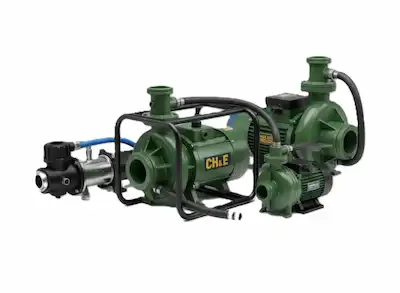
Ken’s Distributing supplies Wacker Neuson dewatering pumps alongside engine driven and diaphragm units from the CH&E and Magnum range.
Tell us the refill rate, the lift out of the hole, the hose run and what the water is carrying, and we will match the pump to the site rather than to the biggest number on the spec sheet.