
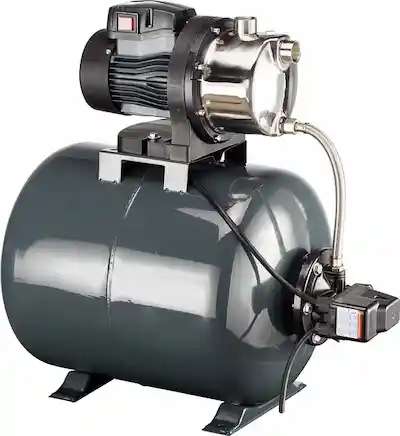
A fountain pump fails for one of two reasons almost every time: the water got too low, or something got into the intake. Neither is the pump’s fault.
Knowing that changes both what you buy and where you put it.
What Size Pump Do You Need for a Fountain?
Fountain pump size follows the nozzle and the height the water must be lifted, not the size of the basin. Work from the nozzle’s rated flow, add the lift, then read the pump’s output at that height rather than at the figure printed on the box.
Key Takeaways
- Size from the nozzle and the lift, not the basin.
- Most fountain pumps must stay fully submerged to cool.
- Low water level is the leading cause of failure.
- Fountain pumps are built for head, pond pumps for volume.
- Bring the pump indoors where winters freeze.
Fountain Pump or Pond Pump?
| Fountain pump | Pond pump | |
|---|---|---|
| Built for | Height | Volume |
| Typical duty | Nozzle or spout | Turnover and filtration |
| Flow | Modest | High |
| Runs | Often on a timer | Continuously with fish |
| Solids | Almost none | Some, with pre-filtration |
Fitting the wrong one is a common and visible mistake. A pond pump on a fountain nozzle produces a weak dribble because it was never built for height, and a fountain pump feeding a pond filter starves it. Our pond pump guide covers the other half of that decision.
Why Water Level Matters So Much
Submersible fountain pumps use the water around them to carry heat away from the motor. Drop the level below the intake and the pump runs dry, overheats and is usually finished in minutes rather than hours.
Evaporation from a fountain is faster than people expect, because the whole point of the design is to throw water into the air. Topping up is maintenance, not an optional extra, and the same dry-running damage is described in our pump mechanical seal guide. General background on the form is in this reference on the fountain.
Keeping One Running
- Check the level more often than feels necessary.
- Rinse the intake screen when flow drops.
- Clear the nozzle, since a fine spray blocks first.
- Keep leaves out with a cover or a screen.
- Bring it indoors before the first hard freeze.
Winter is the one that ends pumps permanently. Water left inside a pump and allowed to freeze expands and cracks the housing, and no amount of care in the spring recovers it. Store the pump submerged in a bucket of water indoors so the seals do not dry out.
When Flow Drops and the Screen Is Clean
If the intake is clear, the nozzle is clear and the level is right, but the fountain still runs weakly, the wear is inside the pump. Grit drawn off the bottom of a basin erodes the impeller the same way it does in any other pump.
Our pump impeller guide covers what that looks like. Raising the pump slightly off the base on a flat stone keeps it out of the silt and prevents most of it, and for a basin that needs emptying rather than circulating, our utility pump guide covers the right tool.
Frequently Asked Questions
What size pump do I need for a fountain?
Fountain pump size is set by the spray or spout you want and the height the water must be lifted to reach it, not by the size of the basin. Work from the nozzle’s rated flow, add the lift, then read what the pump delivers at that height rather than at its headline figure.
What’s the difference between a fountain pump and a pond pump?
The difference between a fountain pump and a pond pump is duty rather than principle. A fountain pump moves modest flow to a decent height through a nozzle, so it is built for head. A pond pump moves much larger volume at low height to turn the water over and feed a filter.
Do fountain pumps need to be submerged?
Most fountain pumps need to be fully submerged, because they use the surrounding water to cool the motor as well as to prime themselves. Running one with the water level below its intake overheats it quickly. Check the minimum operating depth, since low water is what kills most of them.
Do fountain pumps need to run continuously?
A purely decorative fountain with no fish does not need to run continuously and can sit on a timer. Moving water does discourage stagnation and mosquitoes, so many owners run it through the day anyway. A fountain feeding a pond that holds fish is a different case and should stay running.
What are the common problems with outdoor water fountains?
The common problems with outdoor fountains are a clogged pump intake, water level dropping below the pump, a blocked nozzle, and freeze damage in winter. Almost all of them come back to the water level or to debris. Very few are the pump failing on its own without one of those causes.
Fountain Pumps at Ken’s Distributing
Ken’s Distributing carries fountain and water feature pumps in the fountains and water features range, alongside the wider pool equipment and water garden section.
Tell us the nozzle you are feeding and the height to the spout, and we will size the pump at that lift rather than at the flow figure on the carton.