
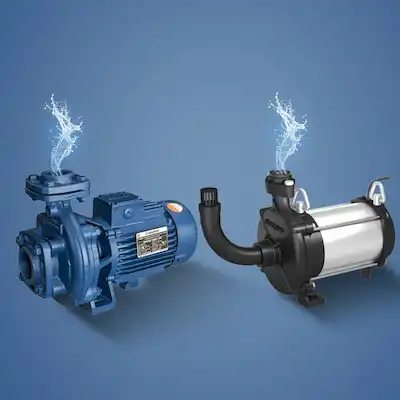
A centrifugal water pump is the most common choice for moving large volumes of low-viscosity liquids such as water because it converts rotational energy from an impeller into fluid flow. Specify against the curve and keep the duty point near best efficiency, because running far off it invites cavitation and shortens bearing life.
Choosing the right pump depends on matching flow rate, total dynamic head (TDH), liquid properties, and operating conditions to the pump’s performance curve.
This guide explains how centrifugal pumps work, the different designs available, and the key factors to consider when selecting a pump for industrial water transfer.
What Is a Centrifugal Pump?
A centrifugal pump is a rotating machine that moves liquids by using an impeller to generate centrifugal force.
As the impeller spins, fluid enters through the inlet at the eye of the impeller and exits through the outer edge into the pump casing, where pressure increases before the liquid reaches the discharge line. Centrifugal pumps use rotational energy from impellers to move fluid efficiently.
Unlike positive displacement pumps, which deliver a fixed volume with every rotation, centrifugal pumps produce continuous flow and are generally better suited for high-volume, low-viscosity liquids such as water.
Their simpler design, lower maintenance requirements, and cost-effectiveness make them a popular choice for many industrial systems.
To better understand the available centrifugal water pump options for industrial water transfer, it’s helpful to compare pump performance with your application’s flow and head requirements.
How Centrifugal Pumps Work
A centrifugal pump converts mechanical power from a motor into hydraulic energy.
The operating sequence is straightforward:
- Fluid enters the suction side through the pump inlet.
- The rotating impeller accelerates the liquid.
- The pump casing captures this velocity.
- Velocity converts into pressure as the liquid moves through the volute or diffuser.
- The liquid leaves through the discharge outlet.
This continuous conversion of rotational energy into hydraulic energy allows centrifugal pumps to handle high fluid flow efficiently.
Most industrial centrifugal pumps operate between approximately 500 and 5,000 rpm, depending on the application and design.
Self-Priming Centrifugal Pump
A self-priming centrifugal pump is designed to remove air from the suction line automatically after the pump has been filled with liquid initially.
Instead of requiring manual priming every time the system starts, the pump retains enough liquid inside its casing to create a vacuum during startup.
This vacuum evacuates air from the pump suction line, allowing the pump to begin moving liquid without additional equipment.
Self-priming designs offer greater convenience but usually have slightly lower pump efficiency than comparable standard centrifugal pumps because of their larger casing and recirculation chamber.
Pump Casing Designs
The pump casing controls how velocity converts into pressure while directing liquid toward the outlet.
The two most common casing designs are:
| Design | Best For |
|---|---|
| Volute casing | General industrial water transfer, wastewater, and liquids containing small solids |
| Diffuser casing | Higher efficiency applications with cleaner liquids |
A volute casing gradually expands around the impeller, slowing the liquid and increasing pressure.
Because of its open geometry, it is generally preferred when occasional solids may be present.
A diffuser casing uses stationary vanes surrounding the impeller to recover pressure more efficiently but is typically used with cleaner liquids.
Types of Centrifugal Pumps
Centrifugal pumps are commonly classified by several design characteristics.
By orientation
- Horizontal pumps
- Vertical centrifugal pumps
- Inline pumps
By impeller stages
- Single-stage centrifugal pumps
- Multistage centrifugal pumps
By liquid characteristics
- Clean water pumps
- Solids handling pumps
- Chemical processing pumps
- Magnetically coupled pumps
This classification helps engineers match pump design with operating requirements.
Multistage Centrifugal Pump
A multistage centrifugal pump contains two or more impellers mounted on the same shaft. Single stage units are covered in our end suction pump guide.
Each additional stage increases the total dynamic head, making these pumps ideal when systems require high discharge pressure rather than extremely high flow rates.
Impellers may be arranged:
- In series to increase the head
- In parallel, to increase flow capacity
Multistage pumps are commonly used for boiler feedwater, high-rise water supply, reverse osmosis systems, and high-pressure industrial applications.
Vertical Centrifugal Pumps
Vertical centrifugal pumps place the motor above the hydraulic assembly while the pump extends into the liquid source.
They are also known as cantilever pumps in some industrial applications.
Advantages include:
- Small installation footprint
- Easy installation in pits or tanks
- Reduced suction lift
- Suitable for cooling towers, municipal water systems, and industrial sumps
Solids Handling Pumps
Some centrifugal pumps are specifically engineered to transport liquids containing suspended solids.
These pumps typically feature:
- Open or semi-open impellers
- Larger internal clearances
- Wear-resistant materials
- Heavy-duty pump casing construction
For abrasive slurries, hardened alloys or high-chrome iron components often provide longer service life by reducing wear and minimizing damage.
Magnetically Coupled Pumps
Magnetically coupled centrifugal pumps eliminate traditional mechanical shaft seals.
Instead, magnetic coupling transfers rotational energy from the motor to the impeller without direct shaft penetration.
Benefits include:
- Reduced leakage risk
- Lower maintenance
- Better containment of hazardous liquids
- Ideal for chemical processing applications
Because there is no mechanical seal, these pumps rely on specialized bearings lubricated by the pumped fluid.
Main Features of a Centrifugal Pump
Several performance specifications should always be reviewed during pump selection.
Key performance metrics include:
- Flow rate
- Total Dynamic Head (TDH)
- Pump efficiency
- Power consumption
- Motor size
- NPSH Required (Net Positive Suction Head)
- Operating speed
- Pump curve
- Best Efficiency Point (BEP)
The pump curve illustrates how flow, pressure, efficiency, and power change under different operating conditions.
Selecting a duty point close to the BEP reduces vibration, energy consumption, and long-term wear.
Limitations and When Not to Use Centrifugal Pumps
Although centrifugal pumps are widely used, they are not ideal for every application.
Limitations include:
- Performance declines with high-viscosity fluids.
- They require liquid for priming unless using a self-priming design.
- Air entering the suction line can cause gas binding.
- Low suction pressure may cause cavitation, damaging the impeller.
- They are unsuitable for precise chemical dosing, where positive displacement pumps perform better.
Cavitation remains one of the most common causes of premature pump damage and should be avoided by maintaining sufficient suction pressure.
Selection Guide for Centrifugal Water Pump
Selecting the right centrifugal water pump starts with identifying the system duty point.
Evaluate these factors:
- Calculate the required flow rate.
- Determine the total dynamic head.
- Match the duty point to the pump curve.
- Verify that NPSH Available exceeds NPSH Required.
- Select compatible materials for the pumped liquid.
- Choose the correct mechanical seal arrangement.
- Confirm motor voltage and power requirements.
- Review the expected operating temperature.
Matching the pump to actual operating conditions improves reliability and extends equipment life.
Maintenance and Troubleshooting
Routine maintenance prevents many common failures.
Recommended inspections include:
- Check bearings regularly.
- Inspect seals for leakage.
- Monitor vibration.
- Verify shaft alignment.
- Clean suction strainers.
- Inspect impeller wear.
- Confirm motor performance.
Signs of cavitation include excessive vibration, unusual noise, reduced capacity, and impeller pitting.
Critical facilities often keep replacement bearings, seals, impellers, gaskets, and coupling components in stock to minimize downtime.
Applications
Centrifugal pumps are used wherever high-flow movement of low-viscosity liquids is required.
Common applications include:
- Industrial water transfer
- Chemical processing
- Municipal water supply
- Agricultural irrigation
- HVAC water circulation
- Cooling systems
- Fire protection systems
- Manufacturing plants
- Water treatment facilities
Many industrial centrifugal pumps can handle flow rates of up to 40,000 gallons per minute, making them suitable for large-scale water movement applications.
Summary
Choosing the right centrifugal water pump begins with understanding the application’s required flow rate, total dynamic head, liquid characteristics, and operating environment.
Reviewing the pump curve, selecting materials compatible with the fluid, verifying NPSH requirements, and operating near the Best Efficiency Point all contribute to reliable long-term performance.
For demanding industrial systems, selecting the correct pump configuration before installation can significantly reduce maintenance costs, improve pump efficiency, and maximize equipment service life.
Frequently Asked Questions
What is a centrifugal pump used for in industry?
In industry a centrifugal pump moves large volumes of relatively thin liquid at a steady pressure, covering water transfer, process cooling, pressure boosting and circulation duties. It is the wrong choice for thick or solid-laden liquid, and for anything that has to be metered precisely, where a positive displacement pump belongs instead.
How do you match a centrifugal pump to a system?
Match a centrifugal pump by working out the total head your system imposes, combining static lift, the pressure required and friction through pipe and fittings, then finding the flow you need at that head on the pump curve. The intersection of those two is the duty point, and it decides the model.
What happens if a centrifugal pump is oversized?
An oversized centrifugal pump runs to the left of its best efficiency point, where recirculation inside the casing causes vibration, noise and early bearing and seal wear. It also draws more current than the job needs. Oversizing feels like a sensible safety margin and is actually the more damaging of the two sizing mistakes.
Do centrifugal pumps need a strainer?
A centrifugal pump handling anything but verified clean water needs a suction strainer, because its internal clearances are tight enough that even modest debris will jam the impeller. Size the strainer openings small enough to protect the pump but large enough that they do not starve it and cause cavitation on the suction side.