
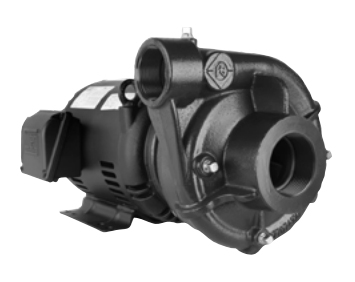
Houses need pumps for more reasons than people expect. Some lift water from a well, some raise pressure that is already there, and some move water the wrong way out of a basement.
Which one you need is decided by where the water comes from, not by the size of the house, and getting that starting point right saves buying the wrong machine entirely.
What Kind of Water Pump Does a House Need?
The water source decides it. A drilled well takes a submersible, a shallow well or cistern takes a jet pump, and a house already on mains water that simply lacks pressure needs a booster, not a supply pump.
Key Takeaways
- Source, not house size, decides the pump type.
- A booster cannot create supply. It only raises pressure that exists.
- Most homes need half to one horsepower and around 10 gallons per minute.
- On a well, the well’s yield caps whatever you fit.
- Most of a replacement bill is labor, not the pump.
Matching the Pump to the Situation
| Your situation | What you need | Guide |
|---|---|---|
| Drilled well, water deeper than 25 ft | Submersible well pump | Sizing a submersible |
| Shallow well, cistern, pond | Jet pump | Shallow well jet pumps |
| Mains water, weak pressure | Booster pump | Booster or water pump |
| Pressure swings when taps open | Constant pressure system | Constant pressure and VFDs |
| Bathroom below the sewer line | Sewage ejector | Sewage ejectors |
| AC or furnace below its drain | Condensate pump | Condensate pumps |
The third row causes the most wasted money. A booster raises the pressure of water already flowing, so if the supply itself is weak or intermittent, a booster will not fix it and may make the symptoms worse.
What It Costs
The pump itself is usually the smaller part of the bill. A house water pump runs roughly $200 to $500, while a complete well pump replacement comes to about $900 to $2,500 installed (This Old House).
Depth explains the gap. A jet pump sitting in a basement is a morning of work. A submersible 300 feet down needs a rig to pull it, and that labor dominates everything else. It is also why fitting a new pump rather than a rebuilt one usually makes sense once the rig is already on site.
Sizing Without Overdoing It
Size on peak simultaneous demand rather than on the number of fixtures, because no household runs everything at once. A shower, a dishwasher and an outside tap is a realistic peak for most homes, and that lands around 10 gallons per minute.
Oversizing is not insurance here. A pump too large for the demand reaches cut-out instantly and short cycles, and starts rather than running hours are what wear a motor out. On a well there is a harder limit still: if the well yields 8 gallons per minute, a bigger pump simply draws the level down toward the intake.
The Part That Decides How Long It Lasts
Not the pump. The pressure tank.
A tank holding its air charge lets the pump rest between draws. A waterlogged one makes it start on every cup of water, and that single fault separates a pump reaching fifteen years from one failing in four. Checking the precharge takes five minutes with a tire gauge, and it is covered in our guide to annual pump servicing.
When output does start to fade, the diagnostic order is set out in telling whether a well pump is bad.
Frequently Asked Questions
How much is a water pump for a house?
A water pump for a house costs roughly $200 to $500 for the pump itself, with a full well pump replacement running about $900 to $2,500 installed according to This Old House. Depth drives the difference, because most of that bill is the labor of reaching the pump rather than the hardware.
What kind of water pump does a house need?
The kind of water pump a house needs is decided by the water source, not by the size of the house. A drilled well takes a submersible, a shallow well or cistern takes a jet pump, and a house already on mains water that simply lacks pressure needs a booster rather than a new supply pump.
What size water pump do I need for my house?
Size a house water pump on peak simultaneous demand rather than on total fixtures, since a household never runs everything at once. A shower, a dishwasher and an outside tap is a realistic peak, and most homes are served by half to one horsepower delivering around 10 gallons per minute. On a well, the well’s own yield caps whatever you install.
How do you install a water pump for a house?
Installing a house water pump means setting the pump, running the discharge to a pressure tank, wiring through a pressure switch and, on a submersible, sizing the drop cable for the depth. Well work and electrical connections are jobs for qualified trades, though sizing and specifying are worth understanding before anyone quotes.
House Water Pumps at Ken’s Distributing
Ken’s Distributing supplies residential pumps across every one of these situations, including 4 inch submersible well pumps for drilled wells and the wider Franklin Electric range. The full lineup by pump family is mapped in our Franklin pump guide.
Tell us the water source, the depth if there is a well, and how many bathrooms the house has, and we will confirm the type and size rather than selling you the next one up.