
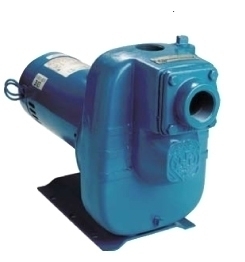
Sprinkler pumps fail in the middle of a dry spell, which is the worst possible timing and also the reason so many get replaced when they did not need to be.
Most of what stops one is a stocked part costing a fraction of a new pump. The trick is knowing which symptom points where before anyone quotes for a replacement.
What Fails on a Sprinkler Pump?
Five components account for nearly every sprinkler pump failure: the mechanical seal, the impeller, the pressure switch, the start capacitor and the foot valve. Seals and impellers wear from sand in the water. Switches and capacitors are electrical parts that age. All five are replaceable.
Key Takeaways
- Most failures are a part, not the pump.
- Lost prime overnight is nearly always the foot valve.
- Sand in the water is what kills seals and impellers.
- A motor failure on an older pump is where repair stops paying.
- Match parts to the pump series, not to the horsepower alone.
Diagnosing by Symptom
| What you see | Most likely cause | Repair or replace |
|---|---|---|
| Loses prime between runs | Foot valve or suction leak | Repair, cheap |
| Runs but pressure is low | Worn impeller or blocked intake | Repair, then reassess |
| Hums and trips | Start capacitor | Repair, cheap |
| Will not cut in or out | Pressure switch | Repair, cheap |
| Water weeping at the shaft | Mechanical seal | Repair while it is early |
| Grinding, then silence | Bearings or motor | Replace on an older pump |
Work down that list in order rather than starting at the bottom. The first four rows cover most call-outs and none of them justifies a new pump.
The Sand Problem
Sprinkler pumps drawing from a well, pond or lake tend to pull fine solids, and that is what wears out the parts that matter. Sand grinds the impeller clearances that generate pressure, then it scores the seal faces.
The symptom is a pump that still runs perfectly but no longer reaches the pressure it used to, which is often mistaken for a failing motor. Where the water carries grit, expect seals and impellers to be periodic replacements rather than one-off repairs.
Replacing an Older Monarch Sprinkler Pump
Monarch’s NSPHE lawn sprinkler series is still working on plenty of properties, and parts for it remain available. Where a unit is genuinely past repair, the Franklin Electric Turf Boss is the closest current equivalent, being a close-coupled self-priming pump built for the same turf and irrigation duty.
Confirm the duty rather than matching the horsepower badge, because flow and head together decide whether a replacement performs like the pump it succeeds. The background to Franklin and Monarch sharing a catalog is in our look at the Monarch acquisition, and the equivalent trash pump crossover is covered in the TT-60 to FTT-40 guide.
Before You Replace It
- Check the foot valve first if the pump will not hold prime.
- Look at the capacitor before condemning a humming motor.
- Read the pressures at cut-in and cut-out against the switch setting.
- Inspect for sand in the strainer and at the discharge.
- Note the series number, since parts are matched to it.
If the pump does need replacing, sizing starts from the largest zone rather than the whole system, as set out in our guide to sprinkler pump sizing.
Frequently Asked Questions
Is a sprinkler pump worth repairing?
Usually yes, a sprinkler pump is worth repairing when the fault is a pressure switch, capacitor, seal or foot valve, since those are a small fraction of a new pump. It stops being worth it once the motor has failed or the impeller is worn on a unit already past its first decade, because the next fault follows soon after.
What parts fail on a sprinkler pump?
The parts that fail on a sprinkler pump are the mechanical seal, the impeller, the pressure switch, the start capacitor and the foot valve on the suction line. Seals and impellers wear from sand in the water, while switches and capacitors are electrical items that simply age. All five are stocked replacement parts rather than reasons to buy a pump.
Why is my sprinkler pump making a loud noise?
A sprinkler pump makes a loud noise for one of three reasons: worn motor bearings, debris trapped against the impeller, or cavitation from a restricted suction line. Grinding points at bearings, rattling at debris, and a sound like gravel moving through the pump means cavitation, which is eroding the impeller while you listen.
Where should the check valve go on a sprinkler pump?
Put the check valve on the discharge side close to the pump, and a separate foot valve at the bottom of the suction line. The foot valve is what holds prime between runs, so a pump losing prime overnight usually has a failed one rather than a pump problem. Keep both accessible for service.
Sprinkler Pump Parts at Ken’s Distributing
Ken’s Distributing stocks sprinkler pump repair parts across the older and current ranges, including Monarch NSPHE S200 repair parts and the wider lawn sprinkler series parts.
Current replacement pumps include the Turf Boss close-coupled self-priming pump and the Red Lion lawn irrigation range. Send us the series number off the pump plate and we will confirm whether the part is still supported.