
Franklin Electric FMIH Series Hydraulic Driven Self-Priming Pump
FMIH 40 Pump Manuals & Resources
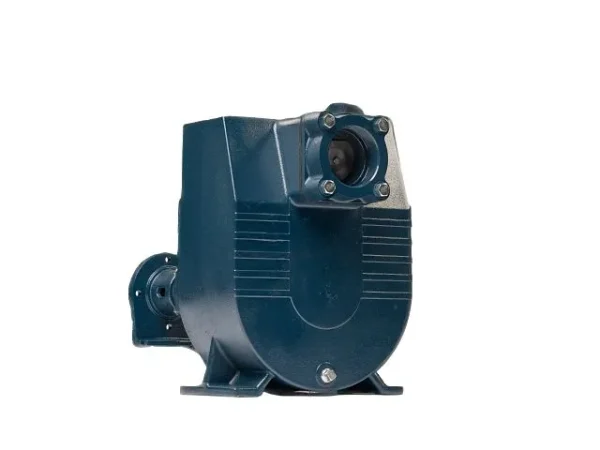
The Franklin Electric FMIH-40 hydraulic-driven self-priming pump is a 4-inch centrifugal water pump designed for installations using a compatible hydraulic drive system. Its cast iron construction, semi-open impeller, and replaceable wear plate suit agricultural irrigation, construction dewatering, water trucks, municipal service, and other demanding water-transfer work. The FMIH series has published performance limits of up to 760 GPM and up to 145 feet of head, with actual operating performance determined by pump speed and the system’s flow and head requirements.
The FMIH-40 is listed under Franklin Electric model FMIH40, order/item number 90295004. The pump has 4-inch threaded FNPT suction and discharge connections, horizontal mounting, and a B-Fit 7/8-inch hydraulic spline shaft. Confirm the complete hydraulic motor, coupling, mounting, rotation, speed, and drive requirements before ordering.
Franklin Electric FMIH-40 Pump Features
- Self-priming centrifugal design: The cast iron casing provides ports for initial priming, venting, and draining. The pump must be filled before initial operation and may require re-priming if it loses retained liquid.
- Semi-open cast iron impeller: Designed primarily for water and capable of handling small quantities of mud, sand, or silt, within the manufacturer’s stated limit of up to 10% by volume.
- Hydraulic drive interface: B-Fit 7/8-inch spline shaft, intended for use with a suitable hydraulic motor and drive arrangement. The spline specification alone does not establish full hydraulic-system compatibility.
- Replaceable wear plate: A serviceable component that helps maintain hydraulic efficiency as running clearances wear.
- Mechanical seal: Carbon/ceramic sealing faces, FKM elastomers, and stainless steel components, as specified by Franklin Electric.
- Heavy-duty bearing frame: Sealed bearings and a keyed stainless steel shaft in the hydraulic-drive configuration.
- 4-inch pipe connections: Threaded FNPT suction and discharge ports to suit compatible piping or hose fittings.
- Horizontal mounting: Install with proper support and drive alignment according to the applicable manufacturer instructions.
FMIH-40 Technical Specifications
| Specification | FMIH-40 |
|---|---|
| Manufacturer | Franklin Electric |
| Series / model | FMIH / FMIH40 (FMIH-40) |
| Order / item number | 90295004 |
| Pump type | Hydraulic-driven, self-priming centrifugal |
| Maximum published series flow | Up to 760 GPM, depending on pump speed and operating head |
| Maximum published series head | Up to 145 feet, depending on pump speed and operating flow |
| Maximum working pressure | 120 PSI |
| Maximum liquid temperature | 212°F (100°C) |
| Suction | 4-inch threaded FNPT |
| Discharge | 4-inch threaded FNPT |
| Rotation | Clockwise when facing the pump shaft |
| Hydraulic drive connection | B-Fit 7/8-inch hydraulic spline shaft |
| Mounting | Horizontal |
| Pump casing and impeller | Cast iron; semi-open impeller |
| Pump shaft material | 316 stainless steel (manufacturer product listing) |
| Mechanical seal | Carbon/ceramic faces, FKM elastomers, stainless steel components |
| Solids concentration | Small quantities of mud, sand and silt up to 10% by volume |
| Impeller diameter | 8.69 inches (manufacturer product listing) |
| Product weight | 282 lb |
| Overall dimensions | 28.77 inches long × 15.75 inches wide × 20.5 inches high (manufacturer product listing; verify clearances for installation) |
Performance note: Maximum flow and maximum head are not delivered at the same operating point. Consult the FMIH performance curve and verify hydraulic motor output, pump speed, suction conditions, and system losses to select an appropriate operating point. Maximum working pressure is an equipment limit, not a guaranteed discharge pressure.
FMIH-40 Ordering Information
| Model | Item number | Discharge × suction | Seal | Rotation | Weight |
|---|---|---|---|---|---|
| FMIH40 / FMIH-40 | 90295004 | 4-inch × 4-inch FNPT | Mechanical | Clockwise facing shaft | 282 lb |
When requesting a quote, provide item 90295004 and the hydraulic motor or equipment details so the required drive connection can be checked.
How the FMIH Hydraulic-Driven Pump Works
Unlike a pump supplied with its own electric or gasoline engine, the FMIH uses a mechanical drive interface intended to be powered by a separately matched hydraulic motor. A hydraulic motor receives flow and pressure from the equipment hydraulic circuit and turns the pump shaft. The speed achieved depends on the motor and circuit characteristics, so the hydraulic source must be assessed as a system rather than assumed to be compatible from the spline size alone.
The self-priming casing helps the pump remove air from the suction line after the housing is initially filled with liquid. Proper priming, an airtight suction line, adequate available suction conditions, and a suitable operating speed remain essential. Do not operate the pump dry.
Applications for Franklin Electric FMIH
- Agricultural irrigation: Transfer water from suitable ponds, canals, tanks, and field sources where a compatible hydraulic power system is available.
- Construction dewatering: Move water containing limited quantities of mud, sand, or silt within the manufacturer’s liquid-handling specifications.
- Water truck equipment: Integrate into purpose-designed truck pumping systems after confirming hydraulic drive requirements and connection compatibility.
- Municipal and commercial water transfer: Use hydraulic-equipped equipment for temporary or mobile transfer applications where the required duty point is within the pump curve.
- Mining and light industrial work: Handle compatible process or site water where water quality, abrasion, temperature, pressure, and operating speed remain within rated limits.
The FMIH is not a general-purpose trash or sewage pump. For abrasive or chemically aggressive liquids, confirm application suitability and maintenance requirements with the manufacturer.
Selecting an FMIH-40 for a Hydraulic System
Confirm hydraulic motor and spline fit
The FMIH uses the manufacturer’s B-Fit 7/8-inch hydraulic spline shaft. Verify the hydraulic motor’s mating interface, direction of rotation, shaft fit, mounting arrangement, and available drive components. A matching nominal spline diameter is not sufficient on its own to confirm interchangeability.
Check the required flow and head
Determine the actual water delivery requirement in GPM and total dynamic head. Compare it with the FMIH performance curve at the anticipated pump speed. Also verify available hydraulic flow, pressure, motor displacement, permissible speed, and drive horsepower with the hydraulic-equipment supplier.
Plan suction and service access
Follow the applicable installation manual for the suction arrangement, priming procedure, mounting, pipe support, and service clearances. Provide access to the priming and draining ports, mechanical seal, and wear plate. Do not operate beyond the manufacturer’s rated speed, temperature, or working-pressure limits.
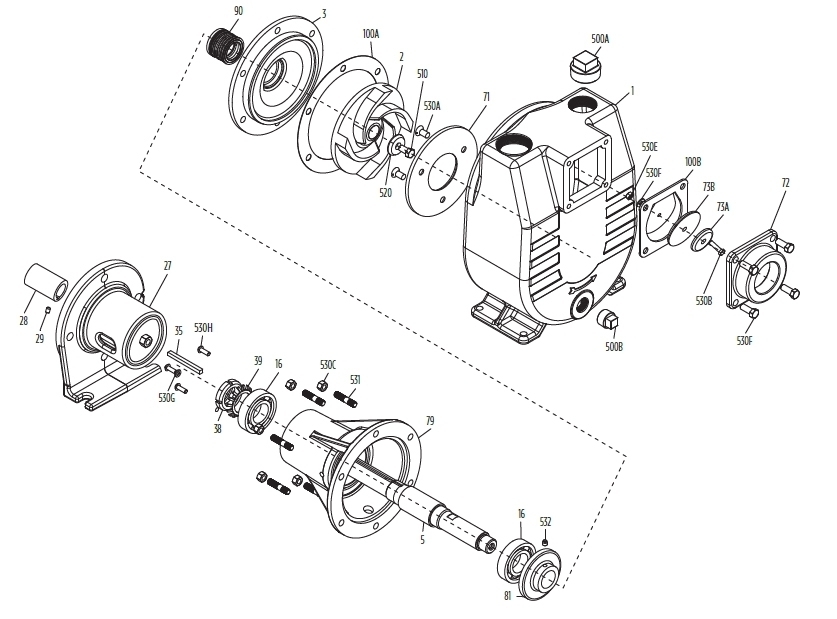
FMIH-40 Exploded Parts Diagram
Franklin Electric FMIH-40 Replacement Parts
The following original manufacturer parts breakdown is retained for identifying service components. Match the figure number and part number to the correct pump and service documentation before purchasing. Replacement-parts availability must be confirmed.
| Fig. no. | Part description | FMIH-40 part number | Materials of construction |
|---|---|---|---|
| 1 | Pump Case | 305455003 | Cast iron, ASTM-A48 CL30 |
| 2 | Impeller | 305455006 | Cast iron, ASTM-A48 CL30 |
| 3 | Seal Plate | 305454009 | Cast iron, ASTM-A48 CL30 |
| 5 | Shaft | 305454015 | 7M-212SST |
| 16 | Ball Bearing (2 required)* | 305463036 | Miscellaneous |
| 27 | Hydraulic Adapter | 305455017 | Cast iron, ASTM-A48 CL30 |
| 28 | Coupling | 305455016 | C1045 carbon steel |
| 29 | Set Screw (2-pack) | 305463198 | Zinc-plated steel |
| 35 | Shaft Key | 305454017 | 1018 CRS |
| 38 | Bearing Nut | 305463039 | 300-series stainless steel |
| 39 | Bearing Lock Washer | 305463042 | Zinc-plated steel |
| 71 | Wear Plate | 305455009 | Cast iron, ASTM-A48 CL30 |
| 72 | Check Valve | 305454020 | Cast iron, ASTM-A48 CL30 |
| 73A | Top Weight, Check Valve | 305454023 | Cast iron, ASTM-A48 CL30 |
| 73B | Bottom Weight, Check Valve | 305454025 | Cast iron, ASTM-A48 CL30 |
| 79 | Transmission Head | 305454033 | Cast iron, ASTM-A48 CL30 |
| 81 | Seal Cover | 305454039 | Cast iron, ASTM-A48 CL30 |
| 90 | Mechanical Shaft Seal | 305463044 | Carbon/ceramic/FKM/316 stainless steel |
| 100A | Case Gasket | 305454042 | NA60 |
| 100B | Flapper Valve | 305454045 | Neoprene |
| 500A | Pipe Plug, 3-inch | 305463197 | CAD-plated steel |
| 500B | Pipe Plug, 3/4-inch (3-pack) | 305463050 | CAD-plated steel |
| Not shown | Pipe Plug, 4-inch | 305463076 | CAD-plated steel |
| 510 | Hex Bolt, Impeller | 305463078 | 300-series stainless steel |
| 520 | Washer, Impeller | 305455015 | 1018 CRS |
| 530A | Wear Plate Bolts (6-pack) | 305463079 | Zinc-plated steel |
| 530B | Flapper Bolt | 305463081 | 300-series stainless steel |
| 530C | Hex Nuts (6-pack) | 305463059 | Zinc-plated steel |
| 530E | Nut, Flapper | 305463083 | Zinc-plated steel |
| 530F | Hex Cap Screw, Valve (4-pack) | 305463086 | Zinc-plated steel |
| 530G | Washer, Bearing Cover (6-pack) | 305463067 | Zinc-plated steel |
| 530H | Bolt, Bearing Cover (4-pack) | 305463069 | Zinc-plated steel |
| 531 | Threaded Stud, Transmission (6-pack) | 305463199 | Zinc-plated steel |
| 532 | Set Screw (2-pack) | 305463075 | Zinc-plated steel |
| 532 | Set Screw | 305463075 | Zinc-plated steel |
* The manufacturer notes that the listed ball-bearing kit contains one bearing even though two bearings are required for the assembly. The two source rows for figure 532 refer to the same part number and are preserved for cross-reference.
FMIH Pump Dimensions
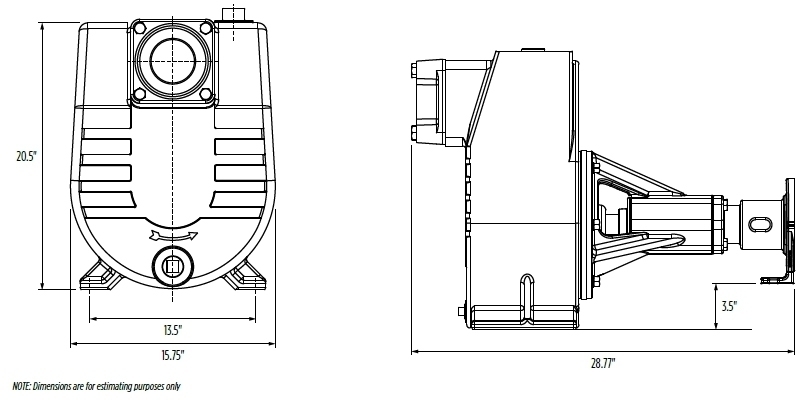
For site planning, Franklin Electric lists the FMIH40 at 28.77 inches long, 15.75 inches wide, and 20.5 inches high. Consult the dimensional drawing before finalizing piping, base supports, or hydraulic motor placement.
FMIH-40 Performance Curve
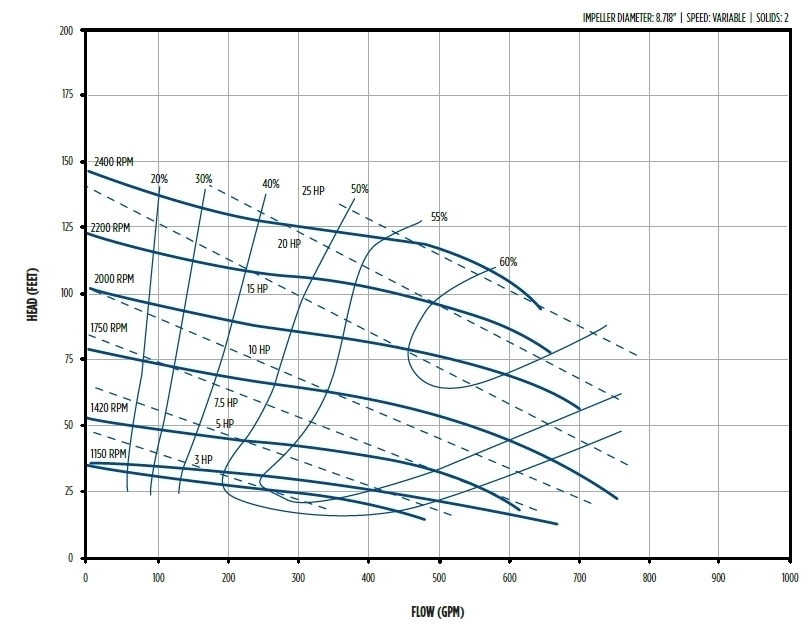
Use the manufacturer’s performance curves to select a feasible flow-and-head combination at the expected operating speed. If you need help reviewing the duty point, include the target GPM, total dynamic head, suction conditions, and hydraulic-drive details with your quote request.
FMIH-40 Frequently Asked Questions
What is the Franklin Electric FMIH-40 pump used for?
The FMIH-40 is a hydraulic-driven self-priming centrifugal water pump for agricultural irrigation, construction dewatering, water trucks, and compatible municipal, commercial, mining, and industrial transfer applications.
What is the FMIH-40 model and item number?
Franklin Electric lists the model as FMIH40, also shown as FMIH-40 in its catalog. The manufacturer item number is 90295004.
Does the FMIH-40 include its own hydraulic motor?
The FMIH is specified with a hydraulic spline drive interface. Confirm with Ken’s Distributing whether the quoted configuration includes any hydraulic motor, coupling, or other drive hardware. Do not assume the pump can attach directly to a tractor hydraulic outlet without a compatible motor and drive arrangement.
What hydraulic spline connection does the FMIH use?
Franklin Electric identifies a B-Fit 7/8-inch hydraulic spline shaft. Verify the mating motor connection, mounting, rotation, and operating requirements before selecting the pump.
How much water can the FMIH-40 pump?
The FMIH series is published with a maximum flow of up to 760 GPM and maximum head of up to 145 feet. Actual flow at a given head depends on pump speed and system conditions. The limits should not be interpreted as simultaneous performance.
Can the FMIH handle sand and silt?
The manufacturer describes the semi-open impeller as capable of handling small amounts of mud, sand, and silt, up to 10% by volume. Abrasion, particle size, and water chemistry still affect suitability and wear.
Does the FMIH need to be primed?
Yes. Fill the pump casing before initial startup and follow the manufacturer’s priming instructions. The pump is designed to self-prime during subsequent starts when sufficient priming liquid is retained and the suction system is properly configured.
Which replacement wear plate fits the FMIH-40?
The FMIH-40 parts catalog lists wear plate 305455009 (figure 71). Verify the pump model and applicable parts breakdown before ordering.
Related Franklin Electric Pumps and Parts
- Franklin Electric FMIT frame-mount self-priming pumps, for configurations using a separately selected belt or direct drive.
- Franklin Electric FMIG gas-engine self-priming pumps, when a gas-engine-driven pump is more suitable.
- Franklin Electric FBSTF frame-mount self-priming pumps, another frame-mount pump family.
- Franklin Electric XS hydraulic-driven centrifugal pumps, for comparison with a non-self-priming hydraulic-driven series.
- Franklin Electric replacement parts and repair kits, for model-specific service components.
Request a Quote for the Franklin Electric FMIH-40
Need the FMIH-40, item 90295004, or a replacement part? Use the quote request form on this page or call 303-699-7845. Share your target flow, head, hydraulic motor or equipment details, and any repair-part numbers. Ken’s Distributing Company can help you check the required configuration and product or parts availability.
Send us your model number and we will confirm fit, price, and availability.