
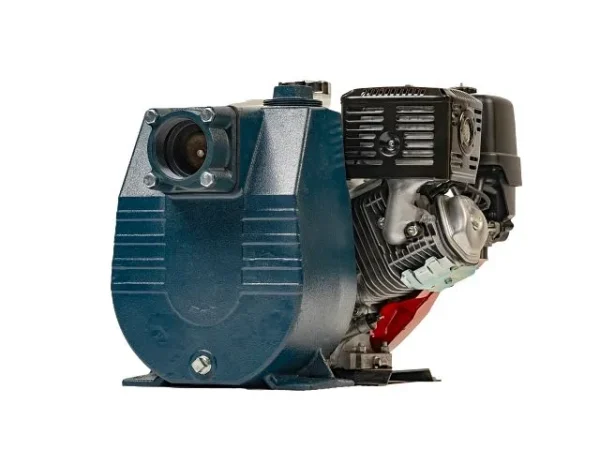
Franklin Electric FMIG Gas Engine Driven Self-Priming Pump
FMIG Pump Manuals & Resources
The Franklin Electric FMIG Gas Engine Driven Self-Priming Pump is a heavy-duty portable centrifugal pump built for agricultural irrigation, construction dewatering, mining, and municipal water transfer applications where high flow rates, self-priming capability, and gas engine independence from electrical power are all required. Delivering flows up to 300 GPM and pressures up to 60 PSI, the FMIG handles water carrying up to 10% mud, sand, and silt by volume with a semi-open cast iron impeller and a replaceable steel wear plate that extends pump service life in abrasive water conditions. At Ken’s Distributing Company, we stock both FMIG models and can help you select the right engine option and port size for your application.
What Is the Franklin Electric FMIG Gas Engine Self-Priming Pump?
The FMIG is Franklin Electric’s frame mount gas engine driven self-priming centrifugal pump series designed for portable and remote high-flow pumping applications. The designation FMIG identifies this as Franklin Electric’s frame mount self-priming pump in the gas engine driven configuration. It is the gas engine powered equivalent of the electric motor driven FMIT frame mount self-priming pump series, sharing the same core design philosophy of high-solids tolerance, self-priming operation, and a replaceable wear plate for extended service life.
Two models cover different flow and power requirements within the series. The FMIG30-13H uses a Honda 289 CC engine with 3-inch connections for moderate high-flow applications. The FMIG40-18K uses a Kohler 624 CC engine with 4-inch connections for maximum flow applications requiring the full 300 GPM capacity of the series.
Kendisco is an authorized Franklin Electric distributor. Every FMIG pump ordered through Ken’s Distributing Company is a genuine Franklin Electric product with full manufacturer support and access to genuine replacement parts.
Technical Specifications
| Specification | Value |
|---|---|
| Max Flow Capacity | Up to 300 GPM |
| Max Pressure | Up to 60 PSI |
| Volute Material | Cast Gray Iron |
| Impeller Type | Semi-Open Cast Iron |
| Solids Handling | Up to 10% mud, sand, or silt by volume |
| Wear Plate | Replaceable Steel |
| Seal | Carbon/Ceramic faces, FKM elastomers, 300 Series Stainless Steel |
| Self-Priming | Yes, with built-in check valve in front cover |
| Mounting Orientation | Horizontal |
Order Information
FMIG Gas Engine Driven Self-Priming Pump
| Item | Model | Engine Brand For Driven Pumps | Engine Size – Driven Pumps (CC) | Suction Diameter | Discharge Diameter |
|---|---|---|---|---|---|
| 90281113 | FMIG30-13H | Honda | 289 | 3 “ | 3 “ |
| 90281218 | FMIG40-18K | Kohler | 624 | 4 “ | 4 “ |
Understanding the FMIG Model Designations
The FMIG model numbers are more descriptive than they first appear. The number after FMIG indicates the pump size. The next number indicates the engine horsepower class. The letter at the end identifies the engine brand.
FMIG30-13H: Frame mount gas engine self-priming pump, size 30, approximately 13 HP class engine, Honda powered. The 3-inch suction and discharge ports are appropriate for the flow range this engine and pump combination delivers.
FMIG40-18K: Frame mount gas engine self-priming pump, size 40, approximately 18 HP class engine, Kohler powered. The 4-inch suction and discharge ports handle the higher flow rates the larger Kohler 624 CC engine produces at the pump.
Contact Ken’s Distributing at 303.699.7845 for specific performance curve data for each FMIG model to match the right combination to your GPM and pressure requirements.
Engine Options: Honda vs. Kohler
The two FMIG models use different engine brands and displacements that serve different flow and power requirements. Here is a direct comparison.
| Feature | FMIG30-13H (Honda) | FMIG40-18K (Kohler) |
|---|---|---|
| Engine Brand | Honda | Kohler |
| Engine Displacement | 289 CC | 624 CC |
| Port Size | 3 inches | 4 inches |
| Flow Capacity | Moderate high flow | Maximum flow, up to 300 GPM |
| Engine Reputation | Fuel efficiency, proven reliability | High output, commercial durability |
| Best Application Scale | Medium irrigation, moderate dewatering | Large irrigation, heavy dewatering, mining |
If your application requires moderate high-flow portable pumping in the 3-inch range and you prefer Honda engine reliability and fuel efficiency, the FMIG30-13H is the right choice. If you need maximum flow capacity from the FMIG series for large-scale agriculture, heavy construction dewatering, or mining applications, the FMIG40-18K with the larger Kohler engine and 4-inch ports delivers the full 300 GPM capacity of the series. Call Ken’s Distributing at 303.699.7845 to discuss which model fits your specific job.
Construction Details
Cast Gray Iron Volute with Priming and Drain Plugs
The FMIG volute is cast gray iron with priming and drain plugs built into the body. The priming plug allows easy filling of the pump housing for the initial startup. The drain plug enables complete housing drainage for winterizing and service without disconnecting any installed piping. Cast gray iron provides the thermal stability and vibration damping characteristics appropriate for a pump running coupled to a gas engine, where mechanical vibration and thermal cycling from engine heat are constant factors during operation.
Removable Front Cover with Built-In Check Valve
The removable front cover serves the same dual function as in the FTSP Series. It provides tool-accessible entry to the pump interior for impeller inspection and front seal service without a complete pump teardown. The built-in check valve in this front cover is the mechanism that makes the FMIG self-priming. By retaining liquid in the pump housing between operating cycles, the check valve ensures the pump has the liquid reservoir it needs to evacuate air from the suction line and establish flow automatically on every restart. This eliminates the need for a separate external foot valve on the suction line in most FMIG installations.
Semi-Open Cast Iron Impeller with 10% Solids Tolerance
The semi-open cast iron impeller with its single-shroud design provides large flow passages that allow mud, sand, and silt up to 10% by volume to pass through without clogging. This 10% solids tolerance is a specific, measurable capability that distinguishes the FMIG from standard centrifugal pumps designed for clean water only. In agricultural irrigation from ponds and canals, construction site dewatering, and mining site water management, the water source regularly carries solids that would clog a standard impeller and take the pump out of service at the worst possible time.
Replaceable Steel Wear Plate
The replaceable steel wear plate sits between the impeller and the volute, maintaining the critical running clearance that determines pump efficiency. As abrasive solids in the pumped water gradually erode this clearance, pump flow and efficiency decline. Rather than replacing the entire pump end when this happens, the wear plate is replaced as a single service component, restoring the original running clearance and performance at a fraction of the cost of a full pump end rebuild. This is a particularly important feature in agricultural and construction applications where the water routinely carries sand and silt that accelerates wear plate erosion compared to clean water service.
FKM Mechanical Seal
The mechanical seal uses carbon and ceramic sealing faces with FKM (Fluoroelastomer) elastomers and 300 Series stainless steel hardware. FKM provides substantially better chemical resistance than standard BUNA or Nitrile elastomers, making the FMIG seal durable in fertilizer solutions, mildly corrosive agricultural water, and elevated temperature applications. The carbon and ceramic faces create an efficient, self-lubricating seal interface that requires the pumped liquid for cooling and lubrication during operation.
Applications and Industries
The FMIG is built for applications where you need the combination of self-priming capability, high solids tolerance, high flow rates, and complete independence from electrical power in a portable package.
- Agricultural Irrigation: Large field irrigation from ponds, rivers, and open water sources in locations without electrical power is the primary application for the FMIG. The 10% solids tolerance handles the organic debris and silt common in agricultural water. The self-priming design manages the repeated start-stop cycles of automated irrigation schedules without operator involvement. The FMIG40-18K with 4-inch ports and Kohler power handles large field applications where the FMIG30-13H flow capacity would be a limiting factor.
- Construction Dewatering: Excavation and trench dewatering in active construction zones before permanent electrical service is established. The FMIG’s self-priming capability and solids handling make it practical for dewatering operations that run overnight or across long unattended shifts.
- Mining: Remote mining site water management in locations where electrical power distribution to pump locations is impractical. The cast iron construction and 10% solids tolerance handle the demanding water quality typical of active mining operations.
- Municipal Emergency Response: Municipalities deploy the FMIG for flood response, water main bypass, and emergency pumping during power outages. The self-priming gas engine combination provides immediate pumping capability without depending on electrical infrastructure that may be disrupted during the emergency.
- Commercial: Large commercial irrigation, golf course remote pumping stations, and commercial agricultural operations where high flow, self-priming, and gas engine independence are all needed together.
- Light Industrial: Portable industrial water transfer, cooling water supply, and site water management in locations without established electrical power connections.
Features and Benefits
- Self-Priming with Automatic Restart: After the initial housing fill, the built-in front cover check valve retains liquid between cycles for automatic re-priming on every subsequent start. No operator involvement required for normal restart cycles during daily operation.
- 10% Solids Tolerance by Volume: The semi-open impeller handles mud, sand, and silt up to 10% by volume. A specific, quantified capability that makes the FMIG genuinely useful in real-world agricultural and construction water conditions where the source is not always clean.
- Replaceable Steel Wear Plate: Restore pump efficiency by replacing the wear plate alone when running clearances wear beyond specification. Significantly less expensive than a full pump end rebuild and extends the overall service life of the pump in abrasive water applications.
- FKM Mechanical Seal: Superior chemical resistance compared to standard seal elastomers. Suitable for fertilizer solutions and mildly aggressive agricultural water chemistry that would degrade BUNA or Nitrile seals prematurely.
- Removable Front Cover for Field Service: Access the impeller and check valve assembly for inspection and clearing without removing the pump from its base. Reduces service time in the field significantly compared to designs that require full disassembly for routine inspection.
- Honda and Kohler Engine Options: Both are well-established commercial engine platforms with broad parts availability and service network access. Choose the brand that best matches your team’s experience and available service resources.
- Up to 300 GPM Flow Capacity: The FMIG40-18K model delivers the highest flow in the FMIG series for large-scale agricultural and industrial applications that exceed the capacity of smaller portable pumps.
- No Electrical Connection Required: Completely self-contained gas engine power. No generator, no electrical hookup, and no power cord management in the field. Position the pump wherever the work is without any electrical infrastructure requirement.
- Horizontal Mounting for Stability: Designed for horizontal installation on a flat surface, skid, or trailer. The horizontal orientation provides stable, vibration-managed operation throughout the duty cycle.
FMIG vs. FMIT: Gas Engine vs. Electric Motor Frame Mount Self-Priming Pumps
The FMIG and FMIT are closely related products that serve the same application types but use different power sources. Understanding the difference helps you choose the right configuration for your installation.
| Feature | FMIG Series | FMIT Series |
|---|---|---|
| Power Source | Gas engine (Honda or Kohler) | Electric motor or belt drive |
| Electrical Power Required | No | Yes, for electric motor drive |
| Portability | Fully portable, self-contained | Requires power source at installation site |
| Self-Priming | Yes, built-in front cover check valve | Yes, priming chamber in volute |
| Solids Handling | Up to 10% by volume | Up to 10% by volume |
| Wear Plate | Replaceable steel | Replaceable wear plate |
| Best For | Remote locations, no power available | Fixed installations with power access |
If you have electrical power available at the installation site and the pump will be in a fixed location, the FMIT electric motor drive configuration is often simpler and less expensive to operate over time. If the pump needs to operate in a remote location without electrical power, or if portability between multiple sites is important, the FMIG gas engine version is the right choice. Call Ken’s Distributing at 303.699.7845 to discuss which configuration fits your installation.
Installation and Setup
- Mounting: Install the FMIG on a flat, stable surface in the horizontal orientation. Secure the unit firmly before connecting hoses. Gas engine vibration on an unsecured unit will stress hose connections and can cause movement during operation that leads to suction line air leaks and loss of prime.
- Initial Priming: Fill the pump housing through the priming plug before the first startup. After the initial fill, the built-in front cover check valve retains enough liquid for automatic re-priming on every subsequent start. The check valve also reduces the need for a separate external foot valve in most installations.
- Suction Line: Connect to the NPT suction port in the correct diameter for your model. Keep the suction line as short and direct as possible with minimal bends. The built-in check valve reduces but does not eliminate suction line air leaks as a performance concern. Ensure all suction connections are air-tight before operation.
- Discharge Line: Match hose diameter to the NPT discharge port. Install a check valve on the discharge side to prevent backflow when the engine shuts down.
- Throttle Management: Start the engine at a lower throttle setting and advance to operating speed after the engine is running smoothly. Avoid sustained full-throttle operation when less throttle provides adequate flow, as reduced engine speed lowers fuel consumption and extends engine service intervals.
- Mechanical Seal: Never run the FMIG dry. The carbon and ceramic seal faces require liquid at all times during operation for lubrication and cooling. Dry running even briefly at gas engine speeds can cause immediate, irreversible seal damage.
- Wear Plate Inspection: Inspect the replaceable steel wear plate at regular intervals, particularly in high-solids applications. Replace when clearance between the impeller and wear plate exceeds the manufacturer specification to maintain rated pump efficiency.
- Winterizing: Remove the drain plug and allow the pump housing to drain completely before storage in freeze conditions. Water left in a cast gray iron housing can cause cracking when it freezes.
- Engine Maintenance: Follow the Honda or Kohler engine maintenance schedule for oil changes, air filter service, and spark plug replacement. Perform a full engine service inspection before each seasonal startup.
Replacement Parts and Service
The replaceable steel wear plate is the most important service component for maintaining FMIG performance in abrasive water applications. The removable front cover design also makes impeller and check valve inspection practical in the field without a full pump teardown.
Ken’s Distributing Company carries genuine Franklin Electric FMIG replacement parts including steel wear plates, FKM mechanical seals, and semi-open impellers. When service components are needed, call us at 303.699.7845 and we will identify the correct parts by model number and get them shipped quickly to minimize your downtime.
For engine service parts, contact your local Honda or Kohler authorized service dealer with the engine model and serial number from the engine data plate.
Browse our Franklin Electric replacement parts and repair kits for the FMIG Series and all other Franklin Electric pump lines.
Frequently Asked Questions
What does FMIG stand for in Franklin Electric pump naming?
FMIG refers to Franklin Electric’s frame mount self-priming pump series in the gas engine driven configuration. It is the gas engine equivalent of the electric motor driven FMIT Series, sharing the same core design of high-solids tolerance, self-priming operation, and a replaceable wear plate for extended service life in abrasive water conditions.
Is the FMIG pump self-priming?
Yes. After the initial housing fill through the priming plug, the built-in check valve in the removable front cover retains liquid between operating cycles. This allows the pump to automatically re-prime and establish flow on every subsequent start without manual intervention. In most installations, the built-in check valve also eliminates the need for a separate external foot valve on the suction line.
How much solids can the FMIG handle?
The semi-open cast iron impeller is rated to handle mud, sand, and silt up to 10% by volume. This makes the FMIG practical for real-world agricultural, construction, and mining water sources that carry suspended solids without the clogging that would stop a standard enclosed impeller pump.
What is the replaceable steel wear plate and when should it be replaced?
The steel wear plate maintains the running clearance between the impeller and the volute. As abrasive solids gradually erode this clearance, pump flow and efficiency decline. When you notice reduced performance compared to original specifications, inspecting and replacing the wear plate is the first corrective step. Replacing the wear plate alone is far less expensive than a full pump end rebuild and restores original pump efficiency.
What is the difference between the FMIG30-13H and FMIG40-18K models?
The FMIG30-13H uses a Honda 289 CC engine with 3-inch connections for moderate high-flow applications. The FMIG40-18K uses a Kohler 624 CC engine with 4-inch connections for maximum flow applications requiring the full 300 GPM capacity of the series. Choose between them based on your GPM requirements and the scale of your pumping application. Call Ken’s Distributing at 303.699.7845 for specific performance data on each model.
Can I get FMIG replacement parts from Kendisco?
Yes. Ken’s Distributing Company carries genuine Franklin Electric FMIG replacement parts including steel wear plates, FKM mechanical seals, and semi-open cast iron impellers. Call 303.699.7845 for availability and fast shipping on all service components.
Related Products
- View the Franklin Electric FMIG branded model page for additional specifications
- Compare with the Franklin Electric FMIT electric motor driven self-priming pump
- See the FNSGF gas engine self-priming pump for additional portable gas engine options
- Compare with the FBSGF gas engine self-priming pump series
- Shop Franklin Electric replacement parts and repair kits for all series
Authorized Franklin Electric Distributor | Get Your Quote Today | Call 303.699.7845 | Repair Parts Available | Fast Shipping Available