
Franklin Electric FMIT Series Frame Mount Self-Priming Pumps
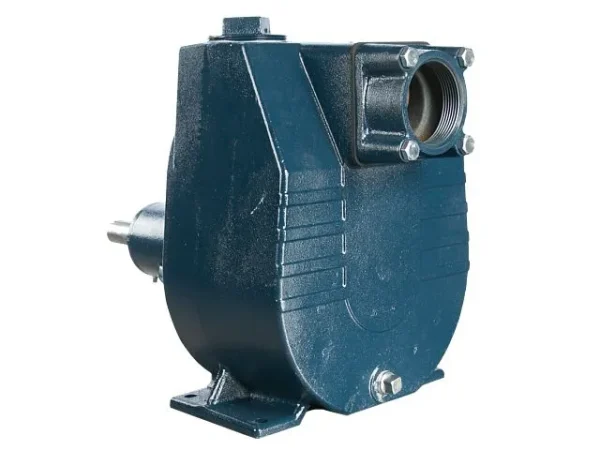
FMIT Series Pump Manuals & Repair Resources
Franklin Electric FMIT Frame Mount Self-Priming Pump Overview
The Franklin Electric FMIT Series is a family of frame-mount, self-priming centrifugal pumps for irrigation, construction dewatering, mining, commercial, municipal and light industrial water transfer, including water truck applications. Three pump-end sizes, FMIT-20, FMIT-30 and FMIT-40, provide 2-inch, 3-inch and 4-inch threaded suction and discharge connections.
Franklin Electric publishes series performance of up to 760 GPM and up to 175 feet of head, depending on pump size, speed and operating conditions. These figures are separate series limits, not a promise that maximum flow and maximum head occur simultaneously. The self-priming volute, semi-open cast iron impeller and replaceable wear plate make the FMIT a practical option when water may contain sand, silt or mud within the manufacturer’s stated limits.
Key Features and Benefits
- Self-priming pump design: The priming chamber supports restarting the priming cycle after the housing has been properly filled and the suction system is correctly installed.
- Semi-open cast iron impeller: Designed for water and capable of handling mud, sand and silt up to 10% by volume, as stated by Franklin Electric. Actual suitability depends on the liquid and operating conditions.
- Three solids-passage ratings: Up to 3/4 inch for FMIT-20, 1 inch for FMIT-30 and 1-3/8 inches for FMIT-40.
- Cast iron volute: Provides tapped openings for priming, venting and draining.
- Replaceable wear plate: Allows worn components to be serviced without replacing the entire pump casing.
- Heavy-duty bearing frame: Sealed bearings and a keyed stainless steel shaft support a separately driven, frame-mounted pump arrangement.
- Mechanical shaft seal: Carbon/ceramic sealing faces with FKM elastomers and stainless steel components.
- Model-specific service components: Replacement pump cases, impellers, wear plates, shaft seals and bearing parts are identified in the repair-parts table below.
Technical Specifications
| Product family | Franklin Electric FMIT frame mount self-priming centrifugal pumps |
|---|---|
| Available models | FMIT-20, FMIT-30, FMIT-40 |
| Published maximum capacity | Up to 760 GPM, model and operating-point dependent |
| Published maximum head | Up to 175 ft, model and operating-point dependent |
| Maximum working pressure | 120 PSI |
| Maximum liquid temperature | 212°F (100°C) |
| Suction / discharge | Threaded FNPT; 2 x 2 in, 3 x 3 in or 4 x 4 in depending on model |
| Impeller | Semi-open cast iron |
| Pump housing | Cast iron |
| Seal | Carbon/ceramic faces, FKM elastomers, stainless steel components |
| Pump shaft | Keyed stainless steel |
| Solids content | Mud, sand and silt, up to 10% by volume as specified by the manufacturer |
| Rotation | Clockwise when facing the shaft |
| Mounting | Frame-mounted pump end; external drive arrangement must be selected for the installation |
Pump performance varies with rotational speed, piping losses, suction conditions and the selected duty point. Use the manufacturer performance curves when choosing a model.
FMIT Model Comparison and Ordering Information
All three models use threaded FNPT suction and discharge connections and a mechanical seal. Select the pump size based on required flow, total dynamic head, available drive speed and the stated maximum solids size, rather than port size alone.
| Model | Pump Size (Dis. x Suc.) | Order No. | Wt. (lbs) | Solid Size |
|---|---|---|---|---|
| FMIT-20 | 2 x 2 | 90230002 | 108 | 3/4″ |
| FMIT-30 | 3 x 3 | 90230003 | 158 | 1″ |
| FMIT-40 | 4 x 4 | 90230004 | 282 | 1-3/8″ |
FMIT-20 (90230002): 2-inch suction and discharge, up to 3/4-inch solids, listed pump weight 108 lb. FMIT-30 (90230003): 3-inch suction and discharge, up to 1-inch solids, listed weight 158 lb. FMIT-40 (90230004): 4-inch suction and discharge, up to 1-3/8-inch solids, listed weight 282 lb.
Applications
- Agriculture and irrigation: Water transfer from appropriate open-water sources when the expected flow, suction conditions and solids content suit the selected pump.
- Construction dewatering: Moving water containing mud or sediment within the manufacturer’s limits.
- Mining and industrial operations: Water management and compatible liquid-transfer duties where a frame-mounted, self-priming configuration is needed.
- Water trucks: Water loading and transfer tasks requiring a suitably sized pump.
- Municipal and commercial work: Utility transfer and other pumping applications requiring the series’ flow range.
How FMIT Self-Priming Works
The FMIT’s volute is designed to support self-priming after the pump casing is filled correctly for initial startup. Retained liquid can assist the pump in clearing air from its suction line during a subsequent restart. Self-priming does not mean the pump can run dry, nor does it remove the need for proper suction piping, priming and operating procedures. Consult Franklin Electric’s installation instructions for the required startup procedure.
FMIT Pump Construction and Service Considerations
Cast Iron Volute and Semi-Open Impeller
The rugged cast iron volute includes priming, venting and draining openings. The semi-open impeller is designed to pump water that may contain some sand, mud or silt, with a stated maximum solids concentration of 10% by volume. The model-specific maximum passage size is shown in the ordering table above; suitability for abrasive or chemically aggressive liquids should be evaluated separately.
Mechanical Shaft Seal and Bearing Frame
Franklin specifies carbon/ceramic seal faces, FKM elastomers and stainless steel components. The separate bearing frame uses heavy sealed bearings and a keyed stainless steel shaft. Match the drive arrangement and operating speed to the manufacturer’s instructions. Do not operate the pump without the liquid conditions required to protect its seal.
Replaceable Wear Plate and Replacement Parts
The replaceable wear plate provides a serviceable wear surface. Inspect its condition and clearances according to the manufacturer’s maintenance guidance. Before ordering repair parts, confirm the model, figure number and existing pump configuration.
Franklin Electric FMIT Exploded Parts Diagram
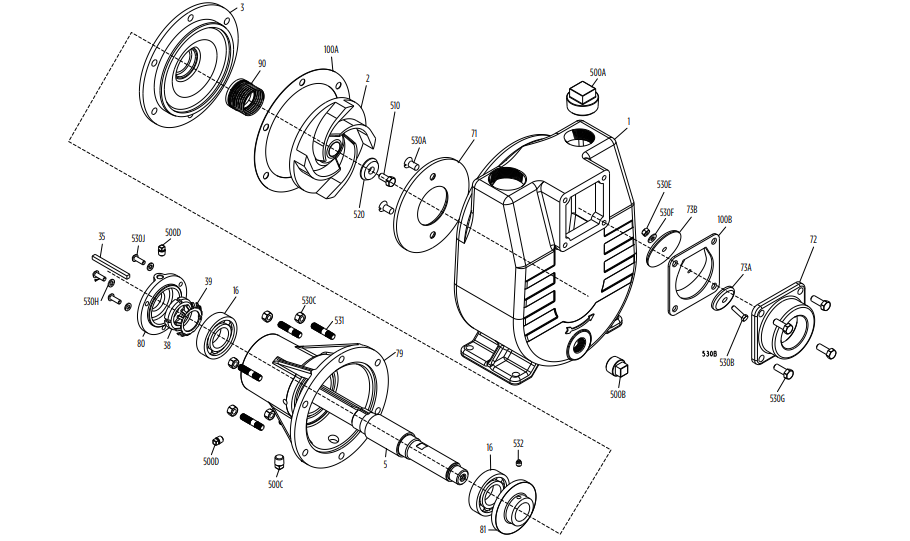
FMIT Repair Parts and Materials of Construction
The following model-by-model replacement-parts table retains the part references from the original Kendisco listing. Always verify model compatibility and any manufacturer supersession before purchasing a repair part.
| Fig. No. | Part Description | Part No. | Materials of Construction | ||
|---|---|---|---|---|---|
| FMIT-20 | FMIT-30 | FMIT-40 | |||
| 1 | Pump Case | 305455001 | 305455002 | 305455003 | Cast Iron, ASTM-A48 CL30 |
| 2 | Impeller | 305455004 | 305455005 | 305455006 | Cast Iron, ASTM-A48 CL30 |
| 3 | Seal Plate | 305454007 | 305454008 | 305454009 | Cast Iron, ASTM-A48 CL30 |
| 5 | Shaft | 305454013 | 305454014 | 305454015 | 316 Stainless steel |
| 16 | Ball Bearing (2 Req.)* | 305463034 | 305463035 | 305463036 | Misc. |
| 35 | Shaft Key | 305454016 | 305454017 | 1018 CRS | |
| 38 | Nut, Bearing | 305463037 | 305463038 | 305463039 | 300 Series Stainless steel |
| 39 | Lock Washer, Bearing | 305463040 | 305463041 | 305463042 | Zinc-plated steel |
| 71 | Wear Plate | 305455007 | 305455008 | 305455009 | Cast Iron, ASTM-A48 CL30 |
| 72 | Check Valve | 305455010 | 305454019 | 305454020 | Cast Iron, ASTM-A48 CL30 |
| 73A | Top Weight, Check Valve | 305455011 | 305454022 | 305454023 | Cast Iron, ASTM-A48 CL30 |
| 73B | Bottom Weight, Check Valve | 305455012 | 305454025 | Cast Iron, ASTM-A48 CL30 | |
| 79 | Transmission Head | 305454031 | 305454032 | 305454033 | Cast Iron, ASTM-A48 CL30 |
| 80 | Bearing Cover | 305454034 | 305454035 | 305454036 | Cast Iron, ASTM-A48 CL30 |
| 81 | Seal Cover | 305454037 | 305454038 | 305454039 | Cast Iron, ASTM-A48 CL30 |
| 90 | Mechanical Shaft Seal | 305463043 | 305463044 | Carbon/Ceramic x FKM-stainless steel | |
| 100A | Case Gasket | 305454040 | 305454041 | 305454042 | Nitrile |
| 100B | Flapper Valve | 305454043 | 305454044 | 305454045 | Neoprene |
| 500A | Pipe Plug, NPT (3 pack) | 305463048 | 305463076 | CAD-plated steel | |
| 500B | Pipe Plug, 3/4″ (3 pack) | 305463050 | CAD-plated steel | ||
| 500C | Pipe Plug, 1/4″ (4 pack) | 305463020 | CAD-plated steel | ||
| 500D | Pipe Plug, 1/8″ (4 pack) | 305463009 | N/A | CAD-plated steel | |
| 510 | Hex Bolt, Impeller | 305463077 | 305463078 | 300 Series Stainless steel | |
| 520 | Washer, Impeller | 305455013 | 305455014 | 305455015 | Aluminum plate |
| 530A | Bolts, Wear Plate | 305463079 | Zinc-plated steel | ||
| 530B | Bolt, Flapper | 305463080 | 305463081 | Zinc-plated steel | |
| 530C | Hex Nut (8/6 pack) | 305463033 | 305463059 | Zinc-plated steel | |
| 530E | Nut, Flapper | 305463082 | 305463083 | Zinc-plated steel | |
| 530F | Washer, Flapper | 305463084 | Stainless steel | ||
| 530G | Valve Hex CapScrew (4 or 8 pack) | 305463010 | 305463085 | 305463086 | Zinc-plated steel |
| 530H | Washer, Bearing Cover | 305463066 | 305463067 | Zinc-plated steel | |
| 530J | Bolt, Bearing Cover | 305463068 | 305463069 | Zinc-plated steel | |
| 531 | Threaded Stud, Transmission (6 pack) | 305463031 | 305463073 | Zinc-plated steel | |
| 532 | Set Screw | 305463074 | 305463075 | Zinc-plated steel | |
FMIT Dimensions and Installation Planning
Use the manufacturer drawing and dimensions for the exact FMIT model, then account for coupling or drive clearance, base mounting, servicing access, and piping support. Dimensions are provided for planning and should be checked against the current manufacturer drawing before fabrication.
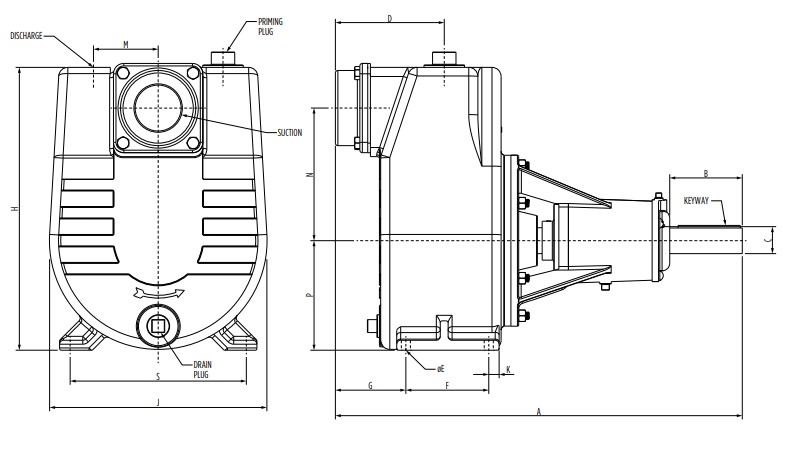
| Model | Keyway | Dimensions (in) | |||||||||||||
|---|---|---|---|---|---|---|---|---|---|---|---|---|---|---|---|
| A | B | C | D | E | F | G | H | J | K | M | N | P | S | ||
| FMIT-20 | 1/4 | 19.63 | 3.50 | 1.250 | 5.25 | 0.44 | 4.00 | 3.40 | 13.66 | 10.50 | 0.50 | 3.13 | 6.16 | 5.29 | 8.50 |
| FMIT-30 | 1/4 | 23.21 | 3.42 | 1.250 | 7.75 | 0.56 | 4.75 | 5.00 | 15.88 | 12.76 | 0.75 | 3.25 | 7.31 | 6.13 | 10.75 |
| FMIT-40 | 3/8 | 27.04 | 3.14 | 1.625 | 8.68 | 0.56 | 6.50 | 4.93 | 20.40 | 15.76 | 0.75 | 4.75 | 9.28 | 8.00 | 13.50 |
Dimensions are in inches and are for estimating purposes only.
FMIT Performance Curves
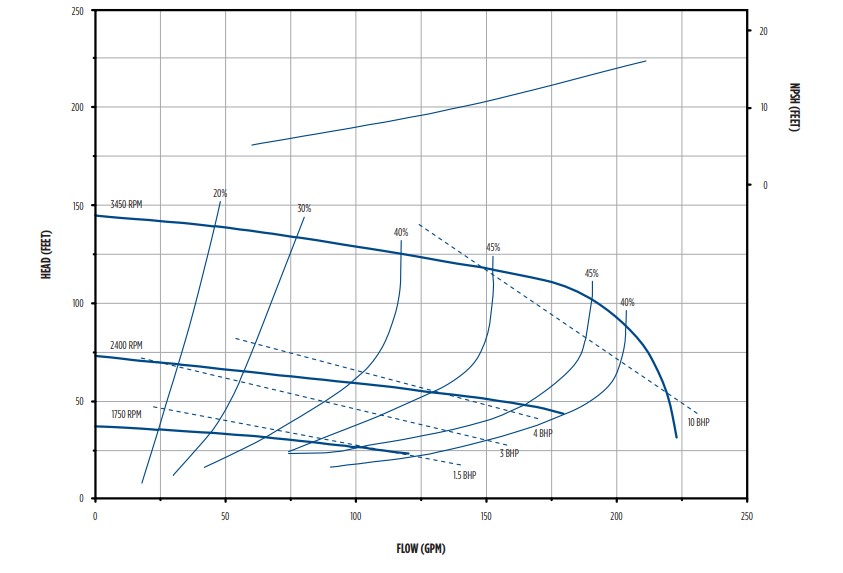
The three original performance charts are retained below. Select a duty point where the required flow and total dynamic head can be achieved at the planned operating speed. Review power requirements and net positive suction head conditions before selecting the drive.
FMIT-20 Performance Curve
FMIT-30 Performance Curve
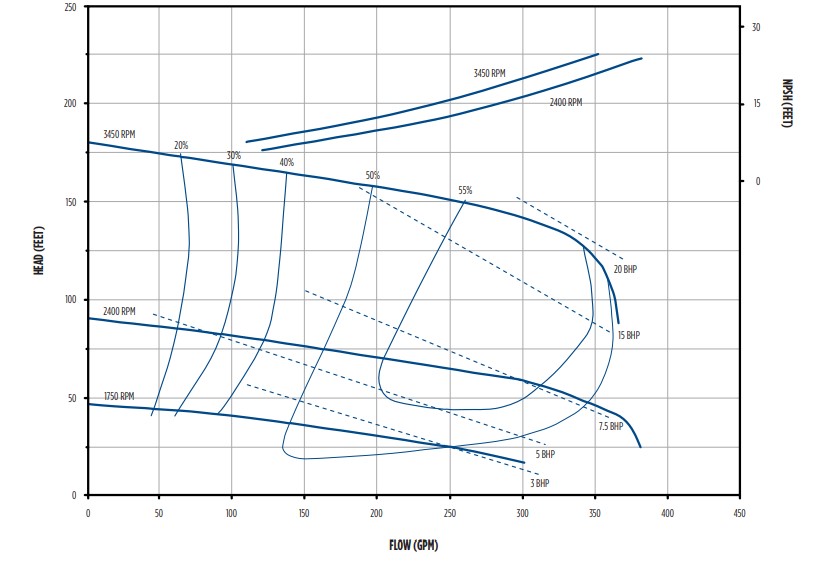
FMIT-40 Performance Curve
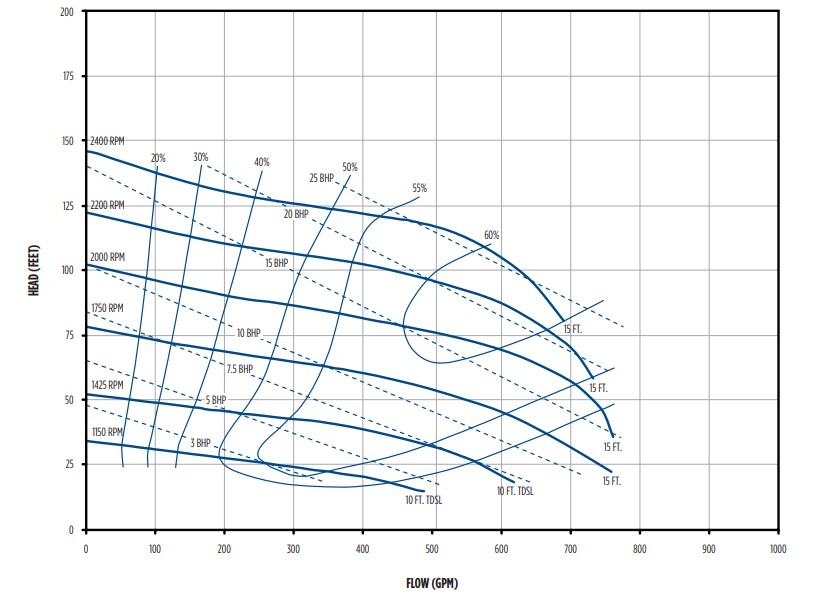
Choosing FMIT-20, FMIT-30 or FMIT-40
Start with the intended flow in GPM and total dynamic head in feet, then match the duty point to a manufacturer curve at a suitable pump speed. Check suction conditions, power availability, model-specific connection sizes and expected solids content. The published maximum flow and maximum head are not interchangeable specifications for a single operating point.
For smaller pumps or a different operating range, compare the Franklin Electric FBSTF frame mount self-priming series. For other frame-mount applications without a self-priming requirement, consider the Franklin Electric FAOT frame mount centrifugal series.
Frequently Asked Questions
Is the Franklin Electric FMIT a self-priming pump?
Yes. The FMIT is a frame-mount self-priming centrifugal pump. Its housing needs to be prepared and filled for initial startup, and the installation must follow the manufacturer’s priming instructions.
Which FMIT models are available?
The three documented pump-end sizes are FMIT-20 (item 90230002), FMIT-30 (item 90230003) and FMIT-40 (item 90230004). Their nominal threaded connections are 2, 3 and 4 inches respectively.
How large a solid can the FMIT handle?
Franklin specifies up to 3/4 inch for FMIT-20, 1 inch for FMIT-30 and 1-3/8 inches for FMIT-40. It also lists mud, sand and silt up to 10% by volume. These limits do not establish suitability for every abrasive slurry or type of debris.
What are the FMIT Series’ maximum flow and head?
Franklin’s catalog lists series capacities up to 760 GPM and heads up to 175 feet. Actual operating performance depends on the model and pump speed, so use the corresponding performance chart.
Does the FMIT use a replaceable wear plate?
Yes. The FMIT features a replaceable wear plate. Model-specific wear plate part numbers appear in the repair-parts table.
Can I buy FMIT replacement parts without replacing the whole pump?
Individual service components are listed for FMIT-20, FMIT-30 and FMIT-40, including pump cases, impellers, mechanical shaft seals, wear plates and bearing hardware. Confirm the part against your exact pump before ordering.
Is the FMIT-20 the only model included on this page?
No. This series page covers FMIT-20, FMIT-30 and FMIT-40. The FMIT-20 item number is 90230002; FMIT-30 and FMIT-40 have separate item numbers and specifications in the ordering table.
Related Franklin Electric Pumps and Parts
- FBSTF Series frame mount self-priming pumps, another Franklin Electric self-priming option to compare by application.
- FAOT frame mount centrifugal pumps, for applications where a self-priming pump is not required.
- Franklin Electric water truck pumps, for additional water-truck pump configurations.
- Franklin Electric replacement parts and repair kits.
Request a Quote for Franklin Electric FMIT Pumps and Repair Parts
Need help selecting the FMIT-20, FMIT-30 or FMIT-40, or identifying a specific replacement component? Contact Ken’s Distributing Company with the pump model, item or part number, and your required flow and head. Call (303) 699-7845 or use the quote request form on this product page to confirm fit, price and availability.
Send us your model number and we will confirm fit, price, and availability.