
Wacker Neuson PT2A-PT3A Self-Priming Trash Pump, Submersible
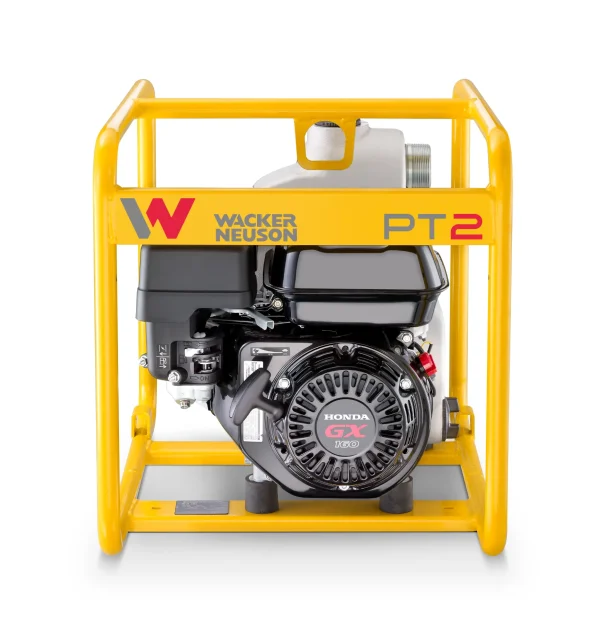
Wacker Neuson PT2A-PT3A Self-Priming Trash Pump for Compact Construction Dewatering
The Wacker Neuson PT2A-PT3A self-priming trash pump range represents the compact entry point in the Wacker Neuson self-priming centrifugal pump lineup, delivering reliable dewatering performance for a wide variety of construction site, civil engineering, and emergency drainage applications. Available through Ken’s Distributing Company, the PT2A is a 2-inch gasoline-powered pump handling solids up to 1 inch (25 mm) in diameter with a maximum flow rate of 165.1 gallons per minute, while the PT3A is a 3-inch model handling solids up to 1.5 inches (38 mm) with a maximum flow rate of 347.4 gallons per minute. Both models are powered by Honda gasoline engines, feature surface-hardened ductile iron impellers, and use carbon ceramic mechanical seals for excellent wear resistance and long service life with minimal maintenance requirements.
The PT2A and PT3A are suited to both clean and sludgy, dirty, sandy, or gritty water, which makes them practical across the varying water quality conditions that characterize active construction and civil engineering sites. Their compact dimensions and light construction make them among the most portable trash pumps in the Wacker Neuson range, and an optional transport kit with a wheel set and fold-down handles extends their on-site mobility further.
PT2A vs. PT3A: Understanding the Key Differences
The PT2A and PT3A share the same core engineering platform but serve different application scales. Selecting the right model depends on the volume of water to be removed and the expected solid size in the pumped fluid.
| Feature | PT2A | PT3A |
|---|---|---|
| Intake/Discharge Size | 2 in | 3 in |
| Max Flow Rate | 165.1 gal/min | 347.4 gal/min |
| Max Solids Diameter | 1 in (25 mm) | 1.5 in (38 mm) |
| Max Delivery Height | 105 ft | 96.8 ft |
| Max Pump Pressure | 46.4 psi | 42.1 psi |
| Max Suction Head | 24.6 ft | 24.6 ft |
| Engine Speed | 3,700 rpm | 3,825 rpm |
| Fuel Consumption | 0.5 GPH | 0.8 GPH |
| Tank Capacity | 0.8 gal | 1.4 gal |
| Run Time Per Tank | 1.8 hrs | 2 hrs |
| Operating Weight | 94.8 lb | 136.7 lb |
| Length | 24.7 in | 26.5 in |
| Width | 18.3 in | 20 in |
| Height | 19.7 in | 22.5 in |
| Best Application | Smaller sites, lower volume, higher head pressure | Medium sites, higher volume, larger solids |
Choose the PT2A when you need a compact, lightweight pump for smaller dewatering volumes and higher delivery height requirements, particularly where the pump’s lower weight and smaller footprint improve handling in confined or restricted access locations. Choose the PT3A when the volume of water to be removed is greater, the expected solids size is larger, or when the additional flow rate of the 3-inch model is needed to keep pace with site water inflow rates.
How Does the Wacker Neuson PT2A-PT3A Self-Priming Trash Pump Work?
Both the PT2A and PT3A operate as self-priming centrifugal pumps. The Honda gasoline engine drives a surface-hardened ductile iron impeller at high speed inside the pump volute. As the impeller rotates, it creates a low-pressure zone at the intake that draws fluid and entrained solid particles upward through the suction hose into the pump chamber. The rotating impeller accelerates the fluid radially outward through the volute and discharges it at high velocity through the outlet port.
The self-priming capability is maintained by retaining a small volume of water in the pump housing between operating cycles. When the Honda engine starts, this residual water allows the impeller to begin building suction immediately, pulling air from the suction hose and drawing water up from the source without requiring the operator to manually fill the pump before each start. On initial deployment or after the pump has been stored dry, adding priming water to the pump chamber before startup will ensure rapid priming and minimize the time before discharge flow is established.
Key Features of the Wacker Neuson PT2A-PT3A Self-Priming Trash Pump
Honda Gasoline Engine for Reliable Power
Both the PT2A and PT3A are powered by Honda gasoline engines, providing the reliability, fuel efficiency, and ease of starting that Honda small engines are recognized for worldwide. The PT2A engine operates at 3,700 rpm and the PT3A at 3,825 rpm, both delivering consistent power output under sustained dewatering loads. Honda engines in this class are known for their long service intervals, wide parts availability, and resistance to the demanding duty cycles encountered in construction site pump applications. The engines are easy to start and straightforward to service, reducing the technical skill and time required for routine maintenance in the field.
Surface-Hardened Ductile Iron Impeller
The impeller in both models is manufactured from ductile iron and surface-hardened to maximize resistance to the abrasive wear generated by solids, sand, and gritty material passing through the pump at high rotational speed. Surface hardening creates a significantly harder outer layer on the impeller while retaining the toughness of the ductile iron core, providing resistance to both abrasion and impact damage. This extends impeller service life substantially compared to standard cast iron or aluminum impellers under the same operating conditions, reducing the frequency and cost of impeller replacement.
Carbon Ceramic Mechanical Seals
The mechanical seals in both PT2A and PT3A models use a carbon ceramic face pairing that provides good wear resistance and reliable sealing integrity in water containing abrasive particles and solid material. Carbon ceramic is a well-proven seal face combination in centrifugal pump applications, offering a balance of hardness, chemical resistance, and thermal stability suited to the variable fluid conditions encountered in construction site trash pumping. These seals contribute to the long operational duration and low maintenance requirements that are characteristic of the PT Series.
Compact and Lightweight Design
The PT2A weighs 94.8 pounds and the PT3A weighs 136.7 pounds, making both models among the most portable options in the Wacker Neuson trash pump range. The compact footprint of the PT2A, at 24.7 inches long and 18.3 inches wide, allows it to be positioned in restricted spaces and loaded into small vehicles or on the back of utility trucks without special equipment. The PT3A remains compact enough for similar handling flexibility despite its higher output capacity. The light construction of both models reflects the use of aluminum components with specialist corrosion-resistant surface treatment, balancing durability with manageable weight.
Optional Transport Kit with Wheel Set and Fold-Down Handles
A transport kit consisting of a wheel set and fold-down handles is available as an accessory for both PT2A and PT3A models. When fitted, the wheel set enables easy rolling repositioning across construction site terrain, while the fold-down handles collapse to minimize overall dimensions during transport and storage. This accessory transforms the handling characteristics of both models significantly, allowing a single operator to move and position the pump with minimal physical effort on active sites.
Central Lifting Eye
Both models are fitted with a central lifting eye that provides a single structurally rated attachment point for crane, hoist, or forklift positioning. The central placement ensures the pump hangs level during lifting, making placement in the correct pumping position straightforward and safe. For applications where the pump needs to be lowered into a confined space, placed on a platform, or positioned across an obstacle, the lifting eye provides the safe attachment required for controlled placement.
Suitable for Clean and Dirty Water Alike
The PT2A and PT3A are specifically designed to handle both clean water and sludgy, dirty, sandy, or gritty water within their respective solids diameter ratings. This dual suitability is an important practical advantage on construction sites where water quality changes throughout the project as different phases of excavation and groundwork produce different levels of contamination. A single PT2A or PT3A can remain in service across these changing conditions without requiring equipment changes.
Technical Specifications: Wacker Neuson PT2A and PT3A
The specifications for the PT2A and PT3A are listed in the same units as provided by Wacker Neuson. Both metric and imperial data reflect the same values for these models.
| Specification | PT2A | PT3A |
|---|---|---|
| Max Flow Rate | 165.1 gal/min | 347.4 gal/min |
| Max Pump Pressure | 46.4 psi | 42.1 psi |
| Max Solids Diameter | 1 in (25 mm) | 1.5 in (38 mm) |
| Max Suction Head | 24.6 ft | 24.6 ft |
| Max Delivery Height | 105 ft | 96.8 ft |
| Intake/Pressure Socket Dia. | 2 in | 3 in |
| Engine Speed | 3,700 rpm | 3,825 rpm |
| Fuel Consumption | 0.5 GPH | 0.8 GPH |
| Tank Capacity | 0.8 gal | 1.4 gal |
| Run Time at Full Load | 1.8 hrs | 2 hrs |
| Operating Weight | 94.8 lb | 136.7 lb |
| Length | 24.7 in | 26.5 in |
| Width | 18.3 in | 20 in |
| Height | 19.7 in | 22.5 in |
| Shipping Length | 45.3 in | 45.3 in |
| Shipping Width | 40.2 in | 29.5 in |
| Shipping Height | 79.1 in | 70.9 in |
| Engine | Honda Gasoline | Honda Gasoline |
Model Variants and Item Numbers
| Model | Item Number | Intake Size | Max Flow Rate | Max Solids Diameter | Engine |
|---|---|---|---|---|---|
| PT2A | 5100058524 | 2 in | 165.1 gal/min | 1 in (25 mm) | Honda Gasoline |
| PT3A | 5100058535 | 3 in | 347.4 gal/min | 1.5 in (38 mm) | Honda Gasoline |
Applications: Where the Wacker Neuson PT2A and PT3A Trash Pumps Perform Best
The PT2A and PT3A are the compact workhorses of the Wacker Neuson trash pump range, suited to a broad range of construction and civil engineering dewatering scenarios where portability, ease of setup, and versatility across water quality conditions are important selection criteria.
- Small to Medium Construction Site Dewatering: Removing accumulated groundwater, rainwater, and surface runoff from smaller excavations, trench sections, and building sites where the flow volume is within the output range of the PT2A or PT3A and a compact, portable pump is more practical than a larger unit.
- Utility and Pipeline Trench Dewatering: Managing water inflow in utility trenches, pipe-laying operations, and cable installation trenches where the confined working space makes a compact pump easier to position and operate alongside other equipment.
- Dirty, Sandy, and Gritty Water Applications: Both models handle clean and contaminated water alike, making them suitable across the range of water quality conditions encountered during active excavation and groundwork on construction sites without requiring pump changes as conditions vary.
- Emergency and Rapid-Response Dewatering: The compact size and lighter weight of the PT2A and PT3A make them practical for rapid deployment in emergency scenarios, easily loaded from a vehicle, positioned at the pumping location, and put to work quickly without the crane or forklift requirements of larger pumps.
- Remote and Off-Grid Locations: Both Honda-powered models are fully independent of electrical power infrastructure, making them suitable for remote construction sites, rural locations, and emergency deployments far from power supply access.
- Civil Engineering and Road Works: Dewatering smaller trench sections, culvert installations, and drainage structure construction on road and infrastructure projects where multiple compact pumps distributed across the site can be more productive than a single large unit.
- Municipal and Utility Maintenance: Dewatering manholes, inspection chambers, and utility vaults during maintenance and inspection operations where compact pump dimensions are essential for access and positioning in confined public infrastructure locations.
Wacker Neuson PT2A-PT3A vs. PTS4 vs. PT6: Full Trash Pump Range Comparison
The Wacker Neuson self-priming trash pump range covers three distinct size classes. The comparison below helps identify which model is appropriate for a given application scale.
| Feature | PT2A | PT3A | PTS4V | PT6 |
|---|---|---|---|---|
| Intake Size | 2 in | 3 in | 3.9 in | Refer to PT6 specs |
| Max Flow Rate | 165.1 gal/min | 347.4 gal/min | 613.4 gal/min | Refer to PT6 specs |
| Max Solids Diameter | 1 in | 1.5 in | 2 in | Refer to PT6 specs |
| Max Delivery Height | 105 ft | 96.8 ft | 78.7 ft | Refer to PT6 specs |
| Engine | Honda gasoline | Honda gasoline | Vanguard gasoline, electric start | Yanmar diesel, electric start |
| Operating Weight | 94.8 lb | 136.7 lb | 330.7 lb | Significantly heavier |
| Mobility | Compact, optional wheel kit | Compact, optional wheel kit | Integrated large wheel set | Central lifting eye, wheeled frame |
| Best Application | Compact sites, smaller volume, high head | Medium sites, moderate volume, larger solids | Medium to large sites, high volume | Large scale, maximum volume, extended shifts |
When the volume of water to be removed or the expected solids size exceeds the capability of the PT3A, the Wacker Neuson PTS4 self-priming trash pump is the next step up, delivering 613.4 gallons per minute with 2-inch solids handling. For the largest scale dewatering operations requiring maximum flow rate and extended diesel-powered operation, the Wacker Neuson PT6 self-priming trash pump is the appropriate choice. If the water on site is relatively clean and high delivery height is more important than solids handling, the Wacker Neuson PG Series engine-driven dewatering pump should also be considered. For applications involving mud, slurry, or very large solids beyond the PT range, the Wacker Neuson PDT diaphragm pump is the appropriate solution.
How to Set Up and Operate the Wacker Neuson PT2A and PT3A Trash Pumps
Both the PT2A and PT3A are designed for straightforward deployment by a single trained operator in most field conditions. The steps below provide general operational guidance only. Always consult the official Wacker Neuson operator’s manual and Honda engine documentation before use.
- Pre-operation inspection: Check the Honda engine oil level and top up if required. Verify fuel level and fill with fresh gasoline if needed. Inspect the pump housing, suction and discharge ports, and all hose connections for damage or loose fittings before starting.
- Attach optional transport kit if fitted: If the wheel set and fold-down handle accessory has been fitted, confirm the handles are in the operating position and the wheel set is secure before positioning the pump at the worksite.
- Position the pump: Use the carry handles or lifting eye to position the pump on stable, level ground as close as practical to the water source. Both models have a maximum suction head of 24.6 feet, so the pump must be placed within this vertical distance of the water surface to prime and operate correctly.
- Connect suction and discharge hoses: Attach the suction hose to the intake port, making sure all connections are tight. Lower the strainer end of the suction hose into the water source. Connect the discharge hose to the outlet and route it to the designated discharge point, keeping the hose run as short and straight as practical.
- Prime the pump: On initial use or after storage, pour clean water into the pump chamber or suction hose to provide the residual water volume needed for self-priming to occur. On subsequent starts, the pump housing will retain sufficient water to re-prime automatically.
- Start the Honda engine: Set the choke to the cold start position if the engine is cold. Open the fuel valve and move the ignition switch to the on position. Pull the recoil starter with a firm, smooth motion. Once the engine starts, allow a brief warm-up at low speed before advancing to operating throttle.
- Confirm priming and discharge flow: Discharge flow should be established within 1 to 2 minutes of the engine running at operating speed. If priming does not occur within this period, shut the engine down, check the suction hose for air leaks, add more priming water, and restart before investigating further.
- Monitor fuel level during operation: The PT2A provides approximately 1.8 hours of run time from its 0.8-gallon tank and the PT3A provides approximately 2 hours from its 1.4-gallon tank at full load. Plan refueling stops accordingly for extended dewatering shifts.
- Shutdown and storage: Reduce engine throttle before switching off. Close the fuel valve after shutdown. If storing for an extended period, flush the pump chamber with clean water to remove residual solids and follow the Honda engine storage procedure to protect the fuel system and internal components.
Frequently Asked Questions: Wacker Neuson PT2A PT3A Self-Priming Trash Pump
What is the Wacker Neuson PT2A-PT3A self-priming trash pump used for?
The Wacker Neuson PT2A and PT3A self-priming trash pumps are used for compact construction site dewatering, utility trench water removal, civil engineering drainage, and emergency flood response applications. Both models handle clean and dirty, sandy, or gritty water, making them practical across a wide range of site conditions. The PT2A suits smaller volume applications and the PT3A covers medium-volume requirements with larger solids handling capacity.
What is the difference between the PT2A and the PT3A?
The PT2A has a 2-inch intake, handles solids up to 1 inch in diameter, delivers up to 165.1 gallons per minute, and achieves a maximum delivery height of 105 feet. The PT3A has a 3-inch intake, handles solids up to 1.5 inches in diameter, delivers up to 347.4 gallons per minute, but has a slightly lower maximum delivery height of 96.8 feet. Choose the PT2A when higher head pressure and a smaller, lighter pump are the priority. Choose the PT3A when higher flow rate and larger solids handling are needed.
Are the PT2A and PT3A self-priming?
Yes. Both the PT2A and PT3A are self-priming centrifugal pumps. After initial priming is established, both models retain enough water in the pump housing to re-prime automatically on subsequent starts. On first use or after extended dry storage, priming water should be added to the pump chamber or suction hose before starting to ensure rapid priming.
What engine do the PT2A and PT3A use?
Both the PT2A and PT3A are powered by Honda gasoline engines. The PT2A engine operates at 3,700 rpm with a fuel consumption of 0.5 gallons per hour, providing approximately 1.8 hours of run time from the 0.8-gallon tank. The PT3A operates at 3,825 rpm with a fuel consumption of 0.8 gallons per hour, providing approximately 2 hours of run time from the 1.4-gallon tank.
What type of water can the PT2A and PT3A handle?
Both the PT2A and PT3A are designed to handle clean water and sludgy, dirty, sandy, or gritty water within their respective solids diameter ratings of 1 inch for the PT2A and 1.5 inches for the PT3A. They are not designed for mud, thick slurry, or very large solids. For those applications, the Wacker Neuson PDT diaphragm pump is the more appropriate choice.
Is a wheel set included with the PT2A and PT3A?
No. The transport kit with wheel set and fold-down handles is available as an optional accessory for both models and is not included as standard. Contact Kendisco for information on accessory availability and pricing when ordering the PT2A or PT3A.
What is the difference between the PT3A and the PTS4?
The PT3A delivers up to 347.4 gallons per minute with a 3-inch intake and handles solids up to 1.5 inches in diameter, weighing 136.7 pounds with a compact form factor. The PTS4V delivers up to 613.4 gallons per minute with a 3.9-inch intake and handles solids up to 2 inches in diameter, but weighs 330.7 pounds and requires the integrated wheel set for site mobility. Choose the PT3A when portability and compact dimensions are important. Choose the PTS4 when higher volume output and larger solids capacity are the priority and the additional weight and size are acceptable for the site conditions.
Where can I purchase the Wacker Neuson PT2A or PT3A self-priming trash pump?
The Wacker Neuson PT2A and PT3A self-priming trash pumps are available through Kendisco, operating as Ken’s Distributing Company, an authorized Wacker Neuson distributor. Contact Kendisco for current pricing, stock availability, delivery options, and accessory information for both models.
Related Wacker Neuson Pumps Available at Kendisco
Ken’s Distributing Company supplies the full Wacker Neuson water pump range. If you are comparing models or evaluating a different specification for your project, the following products may be relevant to your requirements.
- Wacker Neuson PTS4 self-priming trash pump for medium to large-scale dewatering with 613 GPM output and 2-inch solids handling
- Wacker Neuson PT6 self-priming trash pump for large-scale, high-volume dewatering with Yanmar diesel economy
- Wacker Neuson PG Series engine-driven dewatering pump for high-flow clean water removal up to 264 GPM without electrical power
- Wacker Neuson PDT diaphragm pump for mud, slurry, and very large solids that exceed centrifugal pump handling capability
- Wacker Neuson PST Series heavy-duty submersible pump for electric-powered solids-tolerant site dewatering
Send us your model number and we will confirm fit, price, and availability.