
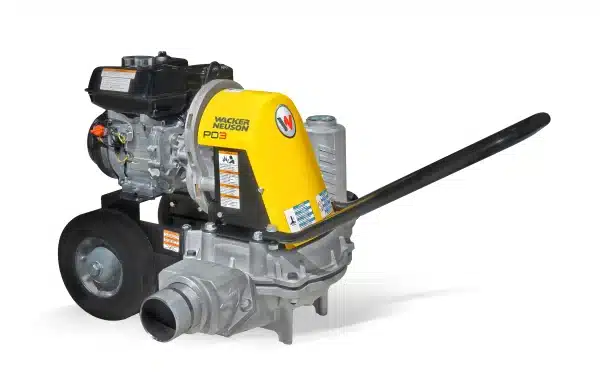
Wacker Neuson PDT Series Diaphragm Pump
Wacker Neuson PDT Series Diaphragm Pump for Mud, Slurry, and Solids
The Wacker Neuson PDT Series diaphragm pump is a Honda-powered, gasoline-engine driven pump engineered to move water, mud, slurry, and solids that centrifugal pumps cannot handle. Available through Ken’s Distributing Company, the PDT Series is offered in two configurations: the PDT3A with a 3-inch intake and solids handling capacity up to 1.6 inches in diameter, and the PDT2A with a 2-inch intake handling solids up to 1.3 inches. With maximum flow rates reaching 88 gallons per minute and a suction head of up to 20 feet, the PDT Series is a practical and durable solution for construction dewatering, seepage control, and any application where the water being pumped is too contaminated for a standard electric submersible pump.
Unlike centrifugal pumps, which rely on high rotational speed to move water and can lose prime when encountering air pockets or heavy solids, a diaphragm pump uses a reciprocating flexible diaphragm to create positive displacement suction. This means the PDT Series can pump thick slurries, muddy water, and material-laden fluids with a consistency that centrifugal pumps cannot sustain, making it the right tool when site conditions are at their most demanding.
How Does a Wacker Neuson PDT Diaphragm Pump Work?
A diaphragm pump operates through a back-and-forth flexing motion of a heavy-duty rubber diaphragm driven by the engine through a gear transmission. On the intake stroke, the diaphragm flexes outward, creating a low-pressure zone that draws fluid into the pump chamber through the inlet valve. On the discharge stroke, the diaphragm flexes inward, pressurizing the chamber and forcing the fluid out through the outlet valve. Because the fluid never contacts the drive components directly, diaphragm pumps can handle highly abrasive, viscous, or solid-laden material without the impeller damage that would occur in a centrifugal pump under the same conditions.
The Wacker Neuson PDT Series adds a surge chamber on the inlet side that absorbs pressure spikes during each pump stroke, smoothing the flow output and reducing wear on internal components over the life of the pump.
Key Features of the Wacker Neuson PDT Series Diaphragm Pump
Straight-Through Water Flow Design
The PDT Series uses a straight-through flow path that allows solids and debris to pass through the pump without accumulating or creating blockage points. This design delivers high pumping capacity while significantly reducing downtime caused by blockages, which is one of the most common productivity losses when pumping construction site water containing solids and fibrous material.
Ductile Iron Crankcase for Maximum Durability
The crankcase housing on the PDT Series is manufactured from ductile iron, a material chosen for its combination of strength, impact resistance, and resistance to fatigue under cyclic loading. Hardened forged gears inside the crankcase provide efficient power transmission from the Honda engine to the pump diaphragm, extending service life and maintaining transmission efficiency across the full operating range of the pump.
Lightweight Cast Aluminum Housing
The pump body uses an aluminum alloy construction that keeps overall weight manageable despite the heavy-duty capability of the unit. The PDT3A ships at 174.2 pounds and the PDT2A at 165.3 pounds, both fitted with large solid rubber tires that provide stable rolling over rough terrain, making repositioning on uneven construction sites practical without requiring additional equipment.
Oil Bath Lubricated Transmission
The gear transmission system runs in an oil bath, ensuring continuous lubrication to all transmission components during operation. This eliminates the need for frequent manual lubrication of the transmission, reduces wear rates on gear surfaces, and lowers the risk of transmission failure due to lubrication breakdown under sustained operation. For contractors running the PDT Series on long dewatering shifts, this system reduces maintenance requirements and protects the investment over time.
Surge Chamber on Inlet Side
The inlet-side surge chamber is a design feature specific to the PDT Series that absorbs the pressure spikes inherent to reciprocating diaphragm pump operation. By dampening these pressure fluctuations before they reach the pump internals, the surge chamber smooths the pumping action, reduces vibration, and extends the service life of the diaphragm, valves, and inlet components.
Honda Gasoline Engine
Both PDT Series models are powered by a Honda single-cylinder gasoline engine with a 118 cc cylinder capacity and a maximum power rating of 3.5 horsepower at 3,600 rpm. The Honda engine is set to an operating speed of 2,800 rpm under load, providing efficient and fuel-economical performance with a fuel consumption rate of 0.3 gallons per hour. The 0.5-gallon tank provides up to 2 hours of continuous operation at full load before refueling is required.
Large Solid Rubber Tires
Both PDT models are mounted on a wheeled frame with large solid rubber tires that provide consistent traction and smooth rolling across rough and uneven ground conditions. This makes repositioning the pump around an active construction site straightforward, even on compacted gravel, mud, or uneven concrete surfaces.
Technical Specifications: Wacker Neuson PDT Series Diaphragm Pump
Complete technical data for both PDT Series models is provided below in metric and imperial units.
Metric Specifications
| Specification | PDT3A (PD13A) | PDT2A (PD12A) |
|---|---|---|
| Max Flow Rate | 333 l/min | 189 l/min |
| Max Solids Diameter | 41 mm | 32 mm |
| Max Suction Head | 6.1 m | 6.1 m |
| Max Delivery Height | 7.6 m | 7.6 m |
| Intake/Pressure Socket Dia. | 75 mm | 50 mm |
| Engine Type | Gasoline | Gasoline |
| Engine Manufacturer | Honda | Honda |
| Cylinders | 1 | 1 |
| Cylinder Capacity | 118 cm3 | 118 cm3 |
| Max Power Rating | 2.6 kW | 2.6 kW |
| Engine Speed at Max Power | 3,600 rpm | 3,600 rpm |
| Operating Engine Speed | 2,800 rpm | 2,800 rpm |
| Fuel | Gasoline | Gasoline |
| Fuel Consumption | 1.1 L/hr | 1.1 L/hr |
| Tank Capacity | 2 L | 2 L |
| Oil Filling Max. | 0.6 L | 0.6 L |
| Running Time at 100% | 2 hrs | 2 hrs |
| Power Standard | SAE J1349 | SAE J1349 |
| Length | 1,102 mm | 1,100 mm |
| Width | 671 mm | 561 mm |
| Height | 594 mm | 589 mm |
| Shipping Weight | 79 kg | 75 kg |
Imperial Specifications
| Specification | PDT3A (PD13A) | PDT2A (PD12A) |
|---|---|---|
| Max Flow Rate | 88 gal/min | 49.9 gal/min |
| Max Solids Diameter | 1.6 in | 1.3 in |
| Max Suction Head | 20 ft | 20 ft |
| Max Delivery Height | 24.9 ft | 24.9 ft |
| Intake/Pressure Socket Dia. | 3 in | 2 in |
| Engine Type | Gasoline | Gasoline |
| Engine Manufacturer | Honda | Honda |
| Cylinders | 1 | 1 |
| Cylinder Capacity | 7.2 in3 | 7.2 in3 |
| Max Power Rating | 3.5 hp | 3.5 hp |
| Engine Speed at Max Power | 3,600 rpm | 3,600 rpm |
| Operating Engine Speed | 2,800 rpm | 2,800 rpm |
| Fuel | Gasoline | Gasoline |
| Fuel Consumption | 0.3 GPH | 0.3 GPH |
| Tank Capacity | 0.5 gal | 0.5 gal |
| Oil Filling Max. | 0.2 gal | 0.2 gal |
| Running Time at 100% | 2 hrs | 2 hrs |
| Power Standard | SAE J1349 | SAE J1349 |
| Length | 43.4 in | 43.3 in |
| Width | 26.4 in | 22.1 in |
| Height | 23.4 in | 23.2 in |
| Shipping Weight | 174.2 lb | 165.3 lb |
PDT Series Model Variants and Item Numbers
| Model | Item Number | Intake Size | Max Flow Rate | Max Solids Diameter | Engine |
|---|---|---|---|---|---|
| PDT3A | 5100075507 | 3 in (76 mm) | 88 gal/min | 1.6 in (41 mm) | Honda Gasoline |
| PDT2A | 5100075510 | 2 in (51 mm) | 49.9 gal/min | 1.3 in (32 mm) | Honda Gasoline |
Applications: Where the Wacker Neuson PDT Diaphragm Pump Performs Best
The PDT Series is specifically designed for situations where standard centrifugal or electric submersible pumps cannot cope with the composition of the fluid being moved. Its ability to handle large solids, thick slurries, and highly contaminated water makes it one of the most versatile pumps in the Wacker Neuson range for demanding site conditions.
- Construction Site Mud and Slurry Removal: Moving thick, mud-laden water from excavations, foundation pits, and trenches where standard dewatering pumps block or lose prime due to the consistency of the fluid.
- Seepage and Contaminated Water Applications: Pumping seepage water containing high concentrations of suspended solids, clay particles, and organic material from construction sites and civil works where water quality is consistently poor.
- Mining and Quarry Dewatering: Removing water containing fine rock particles, slurry, and coarse sediment from quarry faces, mining excavations, and processing areas where abrasive content would damage centrifugal pump impellers.
- Sludge Transfer and Waste Management: Moving sludge, thick waste slurry, and material-laden liquid in industrial, municipal, and environmental remediation applications where viscosity and solids content exceed what centrifugal pumps can manage.
- Flood Response with Heavy Contamination: Clearing floodwater that has accumulated significant sediment, debris, and solid material from building sites, underpasses, and low-lying infrastructure where water quality prevents the use of standard pumps.
- Remote Site Dewatering without Power Access: The Honda gasoline engine makes both PDT models fully self-contained and independent of electrical power infrastructure, making them suitable for remote locations, rural sites, and emergency deployments far from grid power.
- Civil Engineering and Infrastructure Works: Managing water and slurry during road construction, bridge foundation work, culvert installation, and other civil projects where ground conditions produce consistently poor water quality during active excavation.
Wacker Neuson PDT Diaphragm Pump vs. PDI Diaphragm Pump vs. Submersible Pumps: Which Is Right?
Understanding when to use a diaphragm pump versus a submersible pump is one of the most important pump selection decisions on a construction project. The table below provides a direct comparison to help you choose the right equipment for your specific conditions.
| Feature | PDT Series (Diaphragm) | PDI Series (Diaphragm) | PST Series (Submersible) |
|---|---|---|---|
| Pump Mechanism | Positive displacement diaphragm | Positive displacement diaphragm | Centrifugal submersible |
| Drive Type | Honda gasoline engine | Refer to PDI specs | Electric motor |
| Max Solids Diameter | 1.6 in (PDT3A) | Refer to PDI specs | 0.75 in (PSTS 750) |
| Handles Slurry and Mud | Yes | Yes | Limited |
| Power Independence | Yes, gasoline powered | Refer to PDI specs | No, requires electrical supply |
| Max Flow Rate | 88 gal/min (PDT3A) | Refer to PDI specs | 69.8 gal/min (PSTS 750) |
| Best Application | Mud, slurry, large solids, remote sites | Industrial diaphragm pumping | Solids-tolerant site dewatering with power |
When should you choose a diaphragm pump over a submersible pump? If the water on your site contains solids larger than 0.75 inches, if the fluid is thick with mud or slurry, or if no electrical power is available at the site, the PDT Series diaphragm pump is the appropriate choice. For applications involving cleaner water or when an electric power supply is available, the Wacker Neuson PST Series heavy-duty submersible pump or the Wacker Neuson PSA Series submersible pump may be more efficient options. For industrial diaphragm pumping requirements, review the Wacker Neuson PDI Series industrial diaphragm pump.
How to Set Up and Operate the Wacker Neuson PDT Series Diaphragm Pump
The PDT Series is designed for straightforward field deployment. Both models are wheeled for easy positioning. The steps below are provided for general reference only. Always consult the official Wacker Neuson operator’s manual before operating this equipment.
- Pre-operation inspection: Check engine oil level against the dipstick and top up if required. Verify the fuel tank has sufficient gasoline for the planned operating period. Inspect all hose connections, intake screening, and the diaphragm housing for visible damage before starting.
- Position the pump: Roll the PDT to the pumping location using the wheeled frame. Position it on stable, level ground as close to the water source as practical, within the maximum suction head of 20 feet. The closer the pump is to the water surface, the more efficiently it will prime and operate.
- Connect suction and discharge hoses: Attach the suction hose to the intake socket and lower the suction end into the water source. Connect the discharge hose to the outlet and route it to the designated discharge point. Ensure all connections are tight and secure before starting the engine.
- Prime the pump if required: Pour water into the suction hose or pump chamber to assist initial priming if the pump has been dry for an extended period. The PDT is designed for self-priming operation but may benefit from assisted priming after prolonged storage.
- Start the Honda engine: Set the choke to the starting position if the engine is cold. Open the fuel valve, move the engine switch to the on position, and pull the recoil starter cord with a firm, steady motion. Allow the engine to warm up briefly before moving to operating speed.
- Monitor during operation: Confirm that discharge flow is established within the first minute of operation. Monitor fuel level and engine temperature during extended operation. The oil bath lubricated transmission requires no adjustment during normal use but should be checked periodically for oil level as part of routine maintenance.
- Shutdown procedure: Reduce engine throttle before switching off. Close the fuel valve after shutdown. Allow the engine to cool before covering or storing the pump. Flush the pump with clean water if it has been used with heavily contaminated slurry to reduce wear on internal components during storage.
Safety Notice: Always follow the complete instructions in the official Wacker Neuson operator’s manual and the Honda engine manual before operating this equipment. This guidance is for general reference only. Contact Kendisco for access to official documentation, parts, and technical support from Ken’s Distributing Company.
Frequently Asked Questions: Wacker Neuson PDT Series Diaphragm Pump
What is the Wacker Neuson PDT Series diaphragm pump used for?
The Wacker Neuson PDT Series diaphragm pump is used for pumping mud, slurry, solids-laden water, and other fluids that standard centrifugal pumps cannot handle effectively. It is deployed on construction sites, mining and quarry operations, civil engineering projects, and emergency response scenarios where water contains large solids or thick contamination that would block or damage other pump types.
How does a diaphragm pump differ from a centrifugal pump?
A diaphragm pump uses a reciprocating flexible diaphragm to create positive displacement suction, drawing fluid in on one stroke and expelling it on the next. This mechanism allows it to handle thick slurries, large solids, and highly contaminated fluids without losing prime. A centrifugal pump uses a spinning impeller to move water through velocity and cannot sustain operation with heavy solids or very viscous fluids. For muddy, slurry-laden, or large-solids applications, a diaphragm pump is the correct choice.
What size solids can the Wacker Neuson PDT Series handle?
The PDT3A handles solids up to 1.6 inches (41 mm) in diameter, and the PDT2A handles solids up to 1.3 inches (32 mm) in diameter. These ratings are significantly higher than any submersible pump in the Wacker Neuson range, making the PDT Series the appropriate choice when the material being pumped contains rocks, gravel, or large debris fragments.
What engine powers the Wacker Neuson PDT Series?
Both PDT Series models are powered by a Honda single-cylinder gasoline engine with a 118 cc displacement and a maximum power rating of 3.5 horsepower. The engine operates at 2,800 rpm under normal load conditions and consumes approximately 0.3 gallons of fuel per hour, providing up to 2 hours of continuous operation from the 0.5-gallon tank before refueling is required.
What is the maximum suction head of the PDT Series?
Both the PDT3A and PDT2A have a maximum suction head of 20 feet (6.1 meters). Positioning the pump as close as practical to the water surface within this limit will optimize priming performance and flow efficiency. Suction distances beyond 20 feet will result in reduced performance or an inability to prime.
What is the difference between the PDT3A and the PDT2A?
The PDT3A has a 3-inch (76 mm) intake diameter, a maximum flow rate of 88 gallons per minute, and handles solids up to 1.6 inches in diameter. The PDT2A has a 2-inch (51 mm) intake diameter, a maximum flow rate of 49.9 gallons per minute, and handles solids up to 1.3 inches. Both models use the same Honda engine and share the same suction head and delivery height ratings. Choose the PDT3A for higher-volume applications or when larger solids are expected.
What is the difference between the PDT Series and the PDI Series?
The PDT Series is a gasoline engine-driven diaphragm pump designed for construction site and field use where electrical power is not available. The PDI Series is an industrial diaphragm pump configuration intended for different operational requirements. Contact Kendisco for a detailed comparison of the PDT and PDI Series based on your specific application.
Where can I purchase the Wacker Neuson PDT Series diaphragm pump?
The Wacker Neuson PDT Series diaphragm pump is available through Kendisco, operating as Ken’s Distributing Company, an authorized Wacker Neuson distributor. Contact Kendisco for current pricing, availability, and delivery options for both the PDT3A and PDT2A models.
Related Wacker Neuson Pumps Available at Kendisco
Ken’s Distributing Company supplies the full Wacker Neuson water pump range. If you are evaluating other options alongside the PDT Series, the following products may be relevant to your project requirements.
- Wacker Neuson PDI Series industrial diaphragm pump for industrial diaphragm pumping applications
- Wacker Neuson PST Series heavy-duty submersible pump for electric-powered solids-tolerant dewatering
- Wacker Neuson PSA Series submersible pump for dirty water dewatering with automatic operation
- Wacker Neuson PG Series engine-driven dewatering pump for high-flow gasoline-powered site dewatering
- Wacker Neuson PT6 self-priming trash pump for large-volume construction dewatering with solids